A duplicate check identifies whether one person has registered more than once by comparing two submitted selfies. In automated KYC, it is a selfie fraud check distinct from a selfie–ID face check, which compares a selfie with an identity document. section 7.1.3 section 7.4
Implement the check as a face-matching pipeline:
- Detect and crop the face from each selfie with MTCNN. section 7.2.3
- Generate a facial embedding for each cropped face with the pre-trained InceptionResnetV1 model. section 7.2.3
- Compare the embeddings using cosine similarity; higher scores indicate a closer match and lower scores indicate a mismatch. section 7.2.3 section 7.4
Einstein selfie pairs
Two photographs of Albert Einstein produce a cosine similarity of 0.7652, while an Einstein–McCarthy pair scores lower. Identical photographs produce an abnormally high 100% score, which can itself signal suspicious reuse. section 7.2.3
Figure 7.9 Sequence of topics discussed in this section including understanding how face matching works, how the underlying model is trained, and building such a face-matching system for comparing faces across two selfies and across a selfie and an ID.
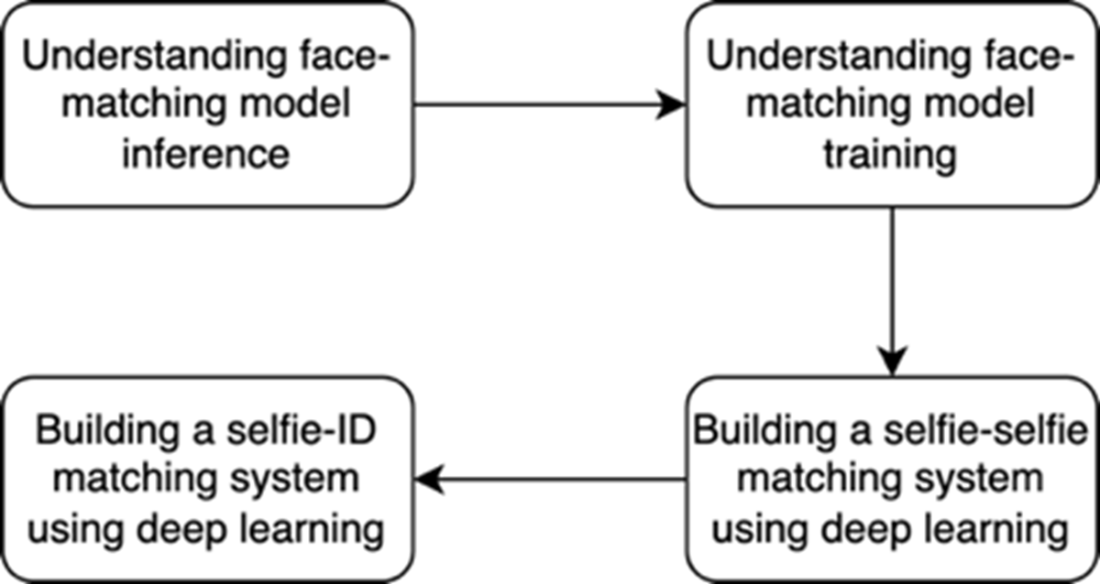
Follow the workflow from pairwise face matching and model training to constructing duplicate and selfie–ID checks. section 7.2
