liveBook · Manning

Cyclic subgroup

As explained in Real-World Cryptography

A cyclic subgroup is a subgroup generated by repeatedly applying its operation to one generator element.

A cyclic subgroup is a subgroup generated from one generator, or base. Repeatedly applying the group operation to that element produces every member of the subgroup. section 5.2.1

Repeating 4 modulo 5

Using multiplication modulo 5, start with 4: 4 = 4, 4 × 4 = 1, 4 × 4 × 4 = 4, and so on. The generator therefore produces the subgroup {1, 4}. Repeated products cycle back to earlier elements. section 5.2.1

Subgroups remain closed under the operation, contain an identity element, and give each element an inverse within the subgroup. Their number of elements is called the subgroup’s order. section 5.2.1

Figure 5.6 The different subgroups of the multiplicative group modulo 5. These all include the number 1 (called the identity element) and have different orders (number of elements).
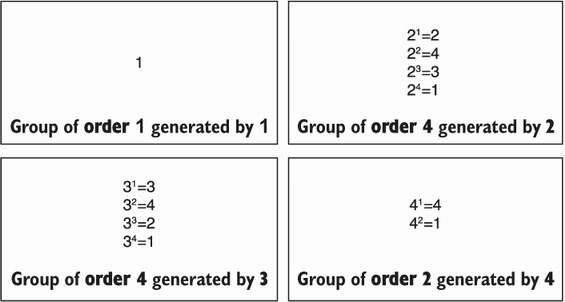
Compare the different subgroups of the multiplicative group modulo 5, including their shared identity element and differing orders. section 5.2.1

How Real-World Cryptography covers it

How deep it goes
Defines generators and subgroup behavior, then works through modular multiplication without proving deeper group-theoretic results.
Examples
Uses the generator 4 modulo 5 and compares modulo-5 subgroups with different orders.
What it assumes
Assumes basic group properties while building subgroup and generator intuition from zero.
What you can do after
Evaluate subgroup generation by repeatedly applying modular multiplication to a chosen generator.
How it connects
Connects cyclic subgroups with groups, subgroups, finite fields, modular multiplication, and Diffie–Hellman.

Related concepts

This explainer was generated by Manning's knowledge graph from the text of Real-World Cryptography. The section links point to the parts of the book it draws on.