D-separation is a graphical test for deciding whether conditioning on a set of variables blocks every path between two variables in a directed acyclic graph (DAG). When the set blocks all paths, the variables are conditionally independent given that set under the graph’s assumptions. It turns a causal question—what should be adjusted for?—into a path-by-path check before fitting an adjustment formula. section 7.1.2 section 7.8
Train delays: conditioning removes shared information
Suppose train service affects whether Jane and Joe arrive late. Their lateness is associated because both respond to train service. Once train service is known, learning that Jane is late adds no useful information about whether Joe is late: train service blocks the only path between them. section 7.1.2
Check each path between X and Y rather than asking whether a variable is generally “good” or “bad” to control for. Conditioning on a middle node in a chain, or on a fork, blocks that path. A collider already blocks its path; conditioning on the collider—or on one of its descendants—can open a new association instead. A conditioning set d-separates X and Y only when every connecting path is blocked. section 7.1.5 section 7.1.6
For causal-effect estimation, use d-separation to inspect adjustment candidates deliberately:
- Identify every path connecting treatment X and outcome Y, including causal paths, confounding paths, and paths containing colliders. section 7.1.5
- Block spurious back-door paths without conditioning on descendants of X, which can remove part of X’s causal effect. section 7.2
- Avoid conditioning on colliders and their descendants unless the full path analysis shows why doing so is appropriate. section 7.1.6
- Choose a set that d-separates X and Y after removing arrows leaving X; this expresses the back-door criterion. section 7.2
Figure 7.13 A graph with three paths from X to Y: a causal path, a path with a confounder, and another with a collider
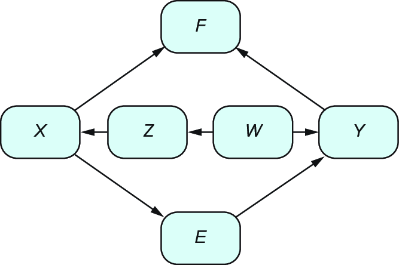
Trace the three paths from X to Y: a causal chain, a confounding path, and a collider path. The diagram makes clear why each path must be assessed separately. section 7.1.5
A DAG is not recovered from data alone: domain knowledge is needed to justify its arrows and variables. D-separation then supplies implications of that assumed graph; it does not make correlation or predictive accuracy into causal proof. Different valid blocking sets may exist, so the goal is to preserve the causal paths of interest while closing spurious ones. section 7.1.6 section 7.8

