liveBook · Manning

Damping exponent

As explained in Knowledge Graphs and LLMs in Action

A damping exponent is a nonnegative exponent that controls how graph degree values reduce the contribution of a path.

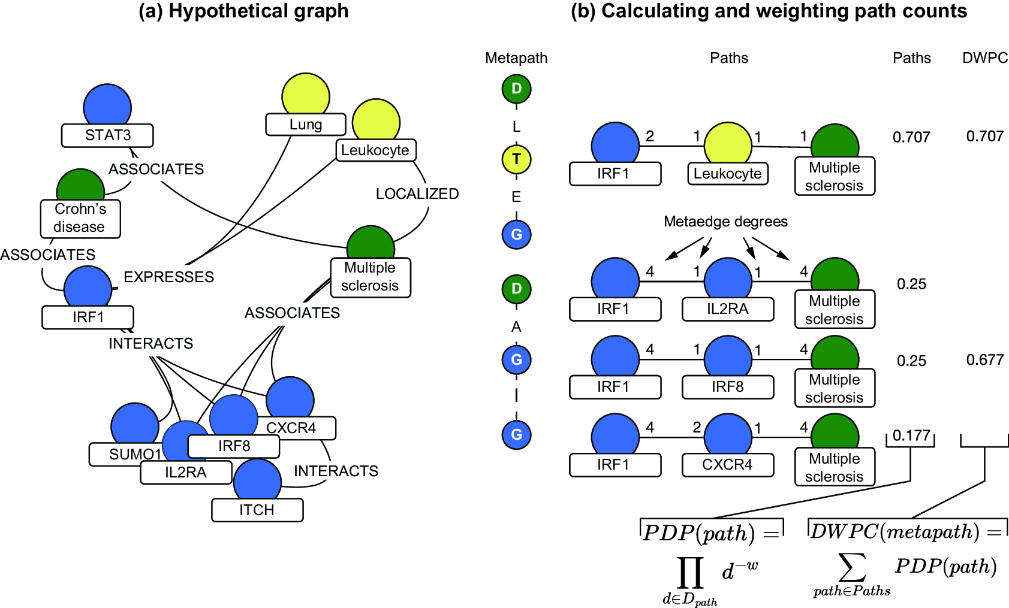
A damping exponent is a nonnegative value that controls how strongly graph degree values reduce a path’s contribution. For each path-degree product, raise every metaedge-specific degree to the negative exponent, then multiply the results. section 4.3

Setting the exponent to zero removes degree-based damping; positive values reduce the influence of highly connected nodes. The resulting path-degree products are summed into the DWPC for a specified metapath. section 4.3

Applying w = 0.5 to a path

For the path IRF1–CXCR4–Multiple sclerosis, extract the degree values contributed by each edge, raise them to −0.5, and multiply the results to obtain its PDP. section 4.3

Figure 4.10 (a) Extracting paths based on a defined metapath, and (b) computing the path-degree product (PDP) and DWPC
figure

Use the path extraction and PDP/DWPC diagram to trace where the damping exponent enters the calculation. section 4.3

How Knowledge Graphs and LLMs in Action covers it

How deep it goes
Explains exponentiation and multiplication within PDP calculation, then connects PDP sums to DWPC without deriving broader metric theory.
Examples
Uses the IRF1–CXCR4–Multiple sclerosis path with w = 0.5 to illustrate PDP calculation.
What it assumes
Assumes familiarity with graph degrees, typed edges, paths, and metapaths.
What you can do after
Evaluate path contributions by applying degree damping before aggregating them into DWPC.
How it connects
Connects degree values to path-degree product, DWPC, metapaths, and knowledge graph path analysis.

Related concepts

This explainer was generated by Manning's knowledge graph from the text of Knowledge Graphs and LLMs in Action. The section links point to the parts of the book it draws on.