The path-degree product (PDP) assigns a connectivity-adjusted value to an individual knowledge-graph path. Extract the two metaedge-specific degree values for every edge incidence, raise each degree to −w, where w ≥ 0 is the damping exponent, and multiply the results. section 4.3
A practical PDP calculation follows this pipeline:
- Select a path matching the required metapath. section 4.3
- Record both relationship-specific degree values contributed by each edge. section 4.3
- Apply the damping exponent to every degree and multiply the resulting values; summing PDPs across paths produces the DWPC for that metapath. section 4.3
IRF1 to multiple sclerosis
For the path IRF1—INTERACTS—CXCR4—[relationship]—multiple sclerosis, the IRF1–CXCR4 edge contributes degree values 4 and 2. With w = 0.5, exponentiate each degree by −0.5 and multiply it with the corresponding factors from the remaining edge incidences. section 4.3
Figure 4.10 (a) Extracting paths based on a defined metapath, and (b) computing the path-degree product (PDP) and DWPC
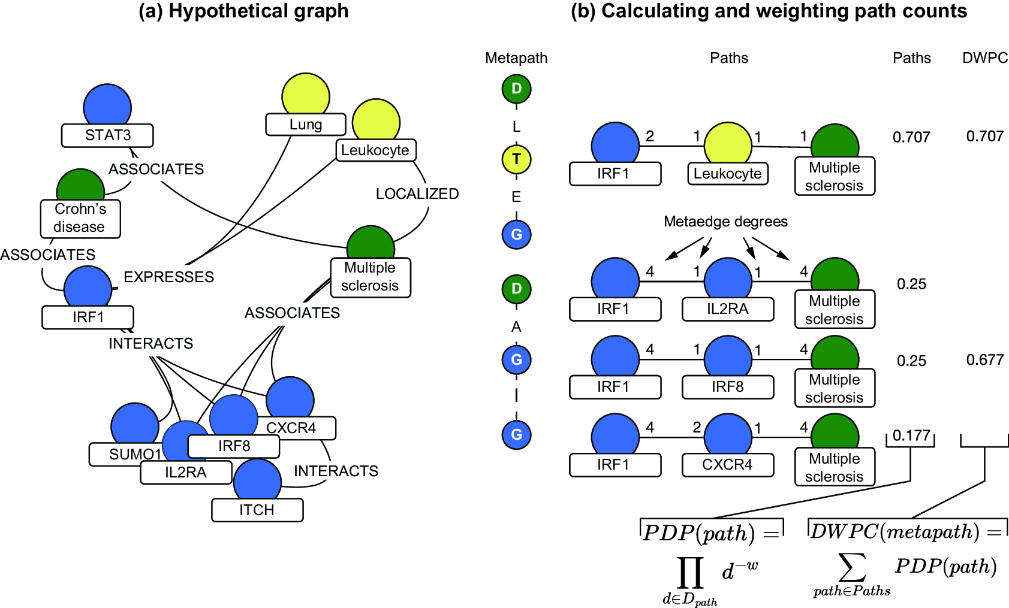
Use the figure to follow metapath-based path extraction and the corresponding PDP and DWPC computations. section 4.3
