A cold-start dataset is a small, curated set of supervised examples that establishes a model’s initial behavior before reinforcement-learning optimization. In DeepSeek-R1, the examples teach a readable reasoning format rather than transferring model parameters. section 7.7.1 section 1.2.3
The dataset addresses several practical weaknesses of starting reinforcement learning from an unstructured model:
- It establishes response style, formatting, and a structured solution with a final-answer region. section 7.7.2
- It improves readability and reduces language mixing observed in purely reinforcement-trained behavior. section 7.7.1 section 7.7.2
- It reduces wasted exploration by making outputs easier for verifiers to parse, producing a cleaner reinforcement-learning signal. section 7.7.2
- It complements reinforcement learning: supervised fine-tuning imitates known formats, while reinforcement learning optimizes outcomes that can be scored. section 7.7.2
Reasoning-format initialization
A small collection of long, readable chain-of-thought examples can teach the model to produce a structured solution followed by a final answer before reasoning-oriented reinforcement learning begins. section 7.7.1 section 7.7.2
Figure 7.14 DeepSeek-R1 training pipeline, adapted from Guo et al., DeepSeek-R1, Figure 2. The flow from R1-Zero into R1 represents filtered training data, not direct parameter transfer.
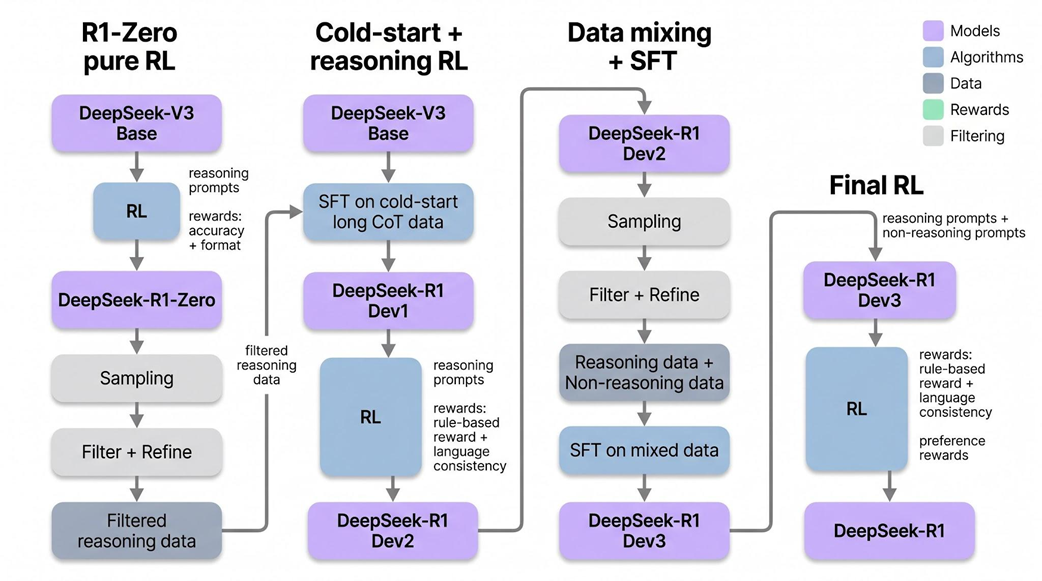
The pipeline distinguishes filtered training-data flow from direct parameter transfer and places cold-start supervision before reasoning reinforcement learning. section 7.7.1
