Data documentation systematically records why a dataset exists, what it contains, how it was collected, how it should be used, and where it may fall short. Datasheets create a shared account between dataset creators and consumers, making decisions about data more visible and reviewable. section 10.17
Useful documentation can cover:
- Motivation, composition, collection process, recommended uses, and relevant limitations. section 10.17
- Dataset cards, which provide a lighter, standardized transparency format with creator-supplied metadata about appropriate uses. section 10.17
- Safety considerations for large language model data, including inaccurate, inappropriate, discriminatory, extremist, violent, or personal content and missing context. section 10.17
- Connections to broader transparency: training-data disclosures, evaluation methods, benchmarking, and system-level interpretation and debugging. section 10.19
A dataset card
A dataset card for the databricks-dolly-15k dataset illustrates how creator-provided metadata can communicate a dataset's intended use in a compact, standardized format. section 10.17
Figure 10.3 A dataset card for the databricks-dolly-15k dataset
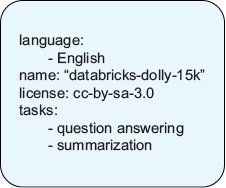
Inspect the dataset card to see how documentation turns a dataset's purpose and metadata into information that consumers can evaluate. section 10.17
