Data efficiency is the ability to achieve a specified reliability or accuracy with relatively few observations. In causal estimation, a data-efficient method reaches a reliable causal-effect estimate with less data than alternatives such as the T-learner. section 8.1.2
Assess data efficiency by considering both empirical performance and theoretical guarantees:
- Generate datasets with different characteristics, apply the method at varying sample sizes, and compare estimated effects with the known effects. section 8.1.2
- Treat experimental results as dataset-specific: they show how quickly a method works on tested data but do not guarantee the same performance elsewhere. section 8.1.2
- Use convergence results for broader confidence; faster convergence means an estimate approaches its objective with fewer observations. section 8.1.2
Figure 8.4 Convergence rate for sequences 1/n and 1/√n. We can see that 1/n converges faster to 0 than 1/√n. The convergence rate of an algorithm tells us how fast this algorithm converges to its objective. In statistics and machine learning, the faster an estimate converges, the less data we need.
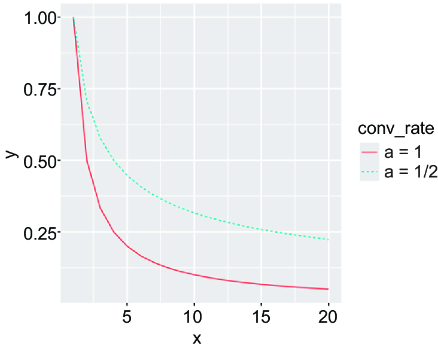
Compare the convergence rates 1/n and 1/√n to see why faster convergence can reduce the data required for estimation. section 8.1.2
