A data lakehouse combines the low cost and flexible storage of a data lake with the governance, reliability, and analytical usability of a data warehouse. It addresses a recurring tradeoff: warehouses can be fast and governed but rigid and expensive, while lakes are flexible and affordable but often fragile, inconsistent, and difficult to operate. section 1.0 section 1.7
Apache Iceberg supplies the table layer that makes this model practical. It treats files on distributed or object storage as managed tables, separates logical table structure from physical storage, supports schema evolution and time travel, and provides snapshot-based transactions with full ACID guarantees for concurrent readers and writers. section 1.0 section 1.5 section 1.7
A modular lakehouse separates responsibilities across five layers:
- Storage keeps data cost-effectively in object storage. section 2.7
- Ingestion writes batch or streaming data into Iceberg tables. section 2.7
- Catalog tracks and governs Iceberg metadata. section 2.7
- Federation connects governed lakehouse tables with external SaaS platforms, legacy databases, real-time services, and other remote sources without requiring replication. section 8.1
- Consumption exposes shared datasets to BI, AI, machine learning, notebooks, and real-time applications through interoperable tools and shared definitions. section 2.7 section 9.1
Figure 2.6 Components of a complete data lakehouse implementation
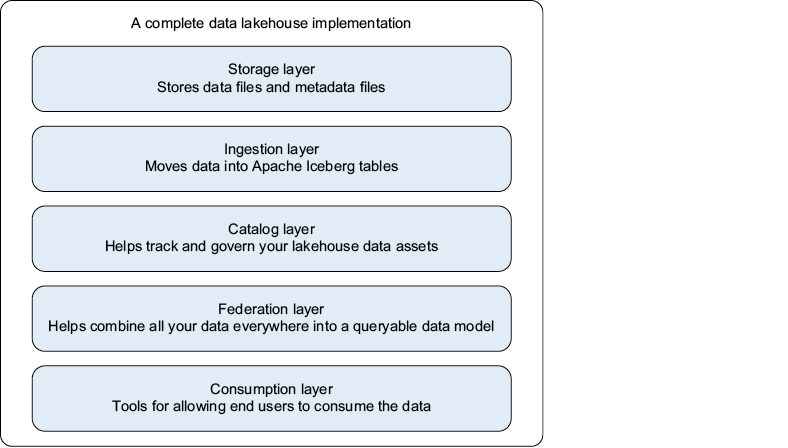
Use the component diagram to see how storage, ingestion, catalog, federation, and consumption layers form a complete lakehouse implementation. section 2.7
Retail sales workflow
A practical workflow starts with fashion sales data in PostgreSQL, uses Apache Spark to write Iceberg tables, curates them in Dremio, defines virtual views for regional and campaign analysis, and delivers dashboards through Apache Superset. The same architectural pattern can support batch, streaming, or event-driven ingestion. section 3.1
Lakehouse adoption remains an operational and organizational decision rather than merely a storage choice. Teams should audit existing pipelines, tools, storage, governance, and user pain points; align requirements across engineering, analytics, compliance, security, and business leadership; then maintain tables through compaction, snapshot retention, metadata monitoring, and resource optimization. section 4.6 section 10.0

