liveBook · Manning

Data portal

As explained in Effective Data Analysis

A data portal is an interactive web interface for discovering, filtering, aggregating, visualizing, and downloading data.

A data portal is an interactive web interface for discovering, filtering, aggregating, visualizing, and downloading data. It helps analysts and stakeholders work with large, complex public datasets without processing every record locally. section 10.3.3

Typical portal-supported tasks include:

  • Searching a repository for a relevant dataset or topic. section 10.3.3
  • Filtering records and selecting only the columns needed for analysis. section 10.3.3
  • Aggregating, visualizing, and downloading subsets directly through the website. section 10.3.3

NYC Open Data and rat sightings

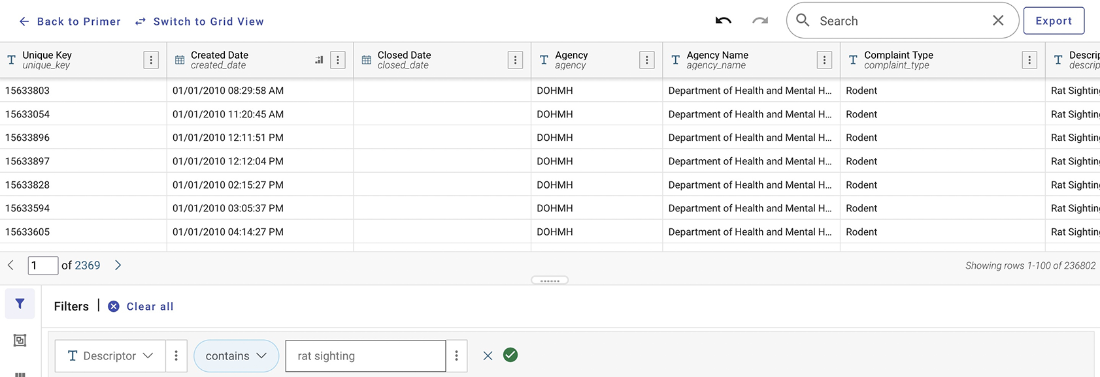
The NYC Open Data portal contains the 35-million-row 311 service-request dataset. Filtering the descriptor for “rat sighting” reduces it to about 236,000 records, producing a more manageable input for statistical modeling. section 10.3.3

Figure 10.19 The NYC Open Data portal allows you to filter, aggregate, and create simple charts.
figure

The portal interface demonstrates filtering, aggregation, and simple chart creation before data is extracted. section 10.3.3

How Effective Data Analysis covers it

How deep it goes
Explains portal querying and basic visualization, but does not address portal construction or governance.
Examples
Uses the NYC Open Data 311 dataset, rat-sighting filters, reduced extracts, simple charts, and JSON query results.
What it assumes
Assumes a concrete analytical question and basic dataset familiarity, while documentation helps map topics to column names.
What you can do after
Operate/configure a portal query to isolate relevant records and columns before downloading or modeling the data.
How it connects
Connects data portals with codebooks, exploratory analysis, data processing pipelines, and statistical modeling.

Related concepts

This explainer was generated by Manning's knowledge graph from the text of Effective Data Analysis. The section links point to the parts of the book it draws on.