A database description (DBD) message is an OSPF message that summarizes a router’s link-state database (LSDB). Routers exchange DBDs while forming an adjacency, first choosing a leader in ExStart and then exchanging summaries in Exchange. section 18.3.1
The DBD exchange fits into OSPF neighbor-state progression:
- In ExStart, routers compare router IDs; the higher RID becomes Leader and the lower RID becomes Follower. section 18.3.1
- In Exchange, routers send DBD messages to learn which LSAs each LSDB contains. section 18.3.1
- In Loading, routers use LSR messages to request specific LSAs, then use LSU and LSAck messages to complete synchronization. section 18.3.1
Figure 18.9 The OSPF neighbor states: Down, Init, 2-Way, ExStart, Exchange, Loading, and Full. Routers that reach the 2-Way state are OSPF neighbors. Some routers remain in this state, and some proceed to establish a full adjacency.
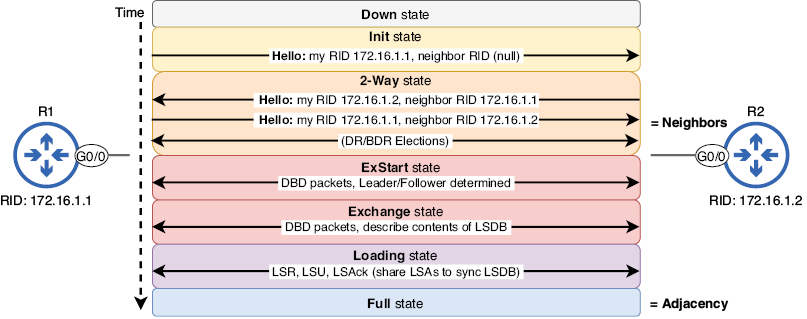
Use the neighbor-state diagram to place ExStart and Exchange between 2-Way and Loading on the path toward Full adjacency. section 18.3.1
