DDIM, or Denoising Diffusion Implicit Models, is an early efficient, non-adversarial method for sampling diffusion models. It improved on DDPM while avoiding the time-consuming adversarial approach associated with GANs. section 6.2.1
Treat DDIM as a practical sampler choice rather than a guaranteed winner:
- At 10 sampling steps, DDIM can produce noticeably different results from Euler and DPM++ 2M. section 6.2.2
- At 30 steps, differences between the three samplers become much subtler. section 6.2.2
- With CFG 10 and only 10 steps, DDIM may outperform DPM++ 2M; increasing the steps reduces that gap. section 6.2.2
- Sampler and schedule-type choices remain partly aesthetic, so comparison is more useful than assuming one universally superior method. section 6.1.2 section 6.2.2
A controlled DDIM comparison
Generate “a sand castle on the beach” with the Deliberate_v5 checkpoint at 512×512, 10 steps, Karras scheduling, seed 1337, and CFG 7. Keep every setting fixed while swapping samplers; then repeat at 30 steps or CFG 10 to see how the differences change. section 6.2.2
Figure 6.7 Exploring 10 steps with 3 different sampling methods.
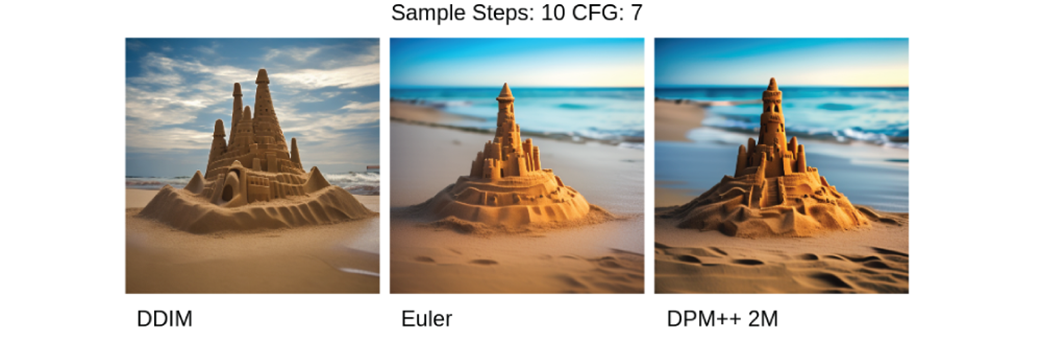
Compare the visible outputs of DDIM, Euler, and DPM++ 2M at ten steps, then follow the related figures for higher step counts and CFG. section 6.2.2