A loan decision is more than a prediction: approval depends on how risk estimates, possible consequences, and judgments about fairness are brought together. A decision framework makes those assumptions and trade-offs explicit. section 1.2.6
Raiffa and Schlaifer structure a decision around acts (available choices), states (unknown and uncontrollable conditions), and experiments (information that could be acquired). For act a, expected utility is E[U(a)] = Σₛ P(s)U(a,s): each act–state outcome is weighted by the probability of that state. Prefer the act with the highest expected utility. section 7.2 section 7.6
The framework makes choice and information-gathering decisions more explicit:
- Decision trees represent acts, uncertain events, and outcomes; rollback works backward to identify the preferred act. section 7.6
- Value-of-information analysis weighs the expected benefit of evidence against its cost. EVPI bounds the value of complete information; EVSI estimates the improvement from imperfect information before cost. section 7.6
- Opportunity loss compares an outcome with the best act that could have been chosen if the true state were known. Minimizing expected opportunity loss selects the same act as maximizing expected utility. section 7.6
Credit approval
An applicant’s data and a model’s risk prediction inform, but do not determine, approval. Decision-makers must also assess reliability, weigh consequences, and consider fairness and regulation. A structured framework clarifies these trade-offs without replacing human judgment or guaranteeing a favorable outcome. section 1.2.6 section 7.6
Figure 1.1 The hidden stack of modern intelligence. Panel A shows the five layers that shape how learning systems are built, evaluated, and used. Panel B lists the book’s foundational works in chronological order from top to bottom. Filled circles show the multiple layers informed by each contribution.
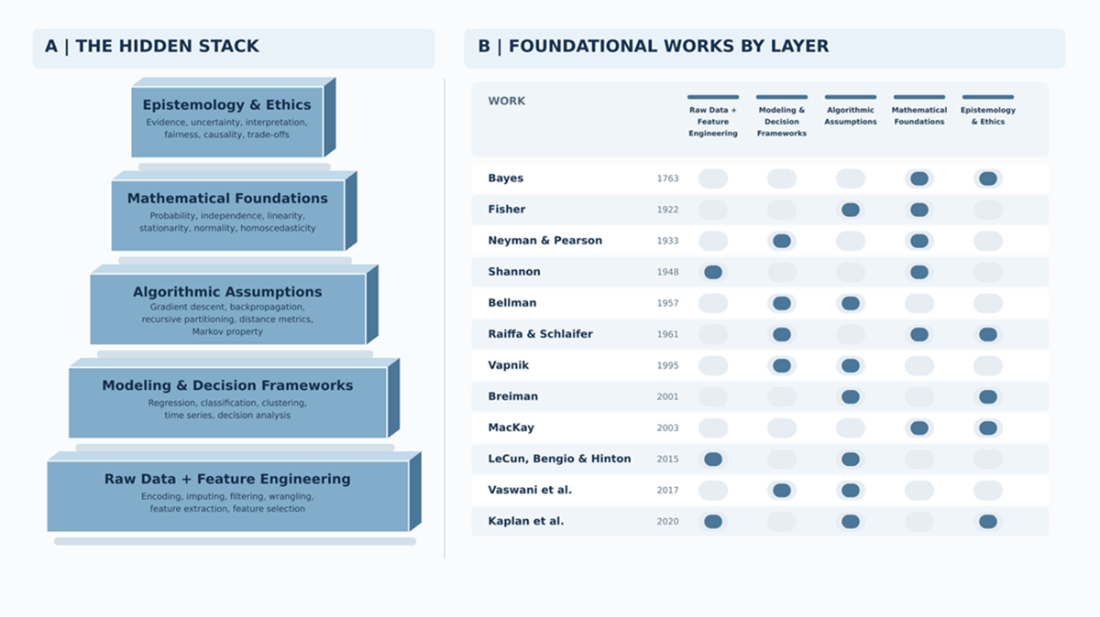
The hidden-stack diagram places decision frameworks among the layers shaping how learning-system results are produced, evaluated, and used. section 1.2


