A decision-making environment is the set of contextual features and arrangements in which people evaluate options and make choices. In collaborative modeling, this includes the session structure, language, available tools, prompts, and social conditions that shape attention, reflection, and participation. section 7.3.3 section 7.3.4
Turn skepticism into reflection
During a BigScreen session, Caelan searched for evidence supporting his existing beliefs, while others became guarded. Rather than arguing, facilitators asked what evidence could change his mind. This type 2 nudge redirected attention toward reflection and gave Caelan space either to reopen the dialogue or state that his position was immovable. section 7.3.3
Good environmental design changes the conditions around a decision instead of relying on awareness alone. A person may recognize a cognitive bias and still be influenced by it, so prompts and structures should help people examine their own reasoning. Additions are generally preferable to removing choices, and nudges should remain sensitive to culture and context. section 7.3.3 section 7.5
Use these practical adjustments when shaping a collaborative decision-making environment:
- Use minimal structure for unfamiliar or complicated scenarios so functional fixedness does not constrain the model. section 7.5
- Ask, “What evidence could change your mind?” when confirmation bias appears. section 7.5
- Replace an ambiguous or overused word, or temporarily restrict its use, and observe whether the model changes. section 7.5
- Make collaborative modeling easy to start by keeping visualization tools available during meetings. section 7.5
- Test a session with two engaged participants when many people may remain idle, then adjust the environment. section 7.5
Figure 7.6 Nudges are organized based on their type and level of transparency. The figure highlights the significance of visually categorizing nudges into quadrants before application. For transparent type II nudges, individuals are informed and provided time to consider whether they wish to respond to the nudge. On the other hand, nudges that fall into the Type I, Nontransparent category are characterized by a lower awareness among people that nudges are being applied. These can potentially manipulate individuals, and the lower they are placed within this quadrant, the more unethical their use becomes. This framework serves as a guide for ethically applying nudges by understanding their effect on awareness and choice.
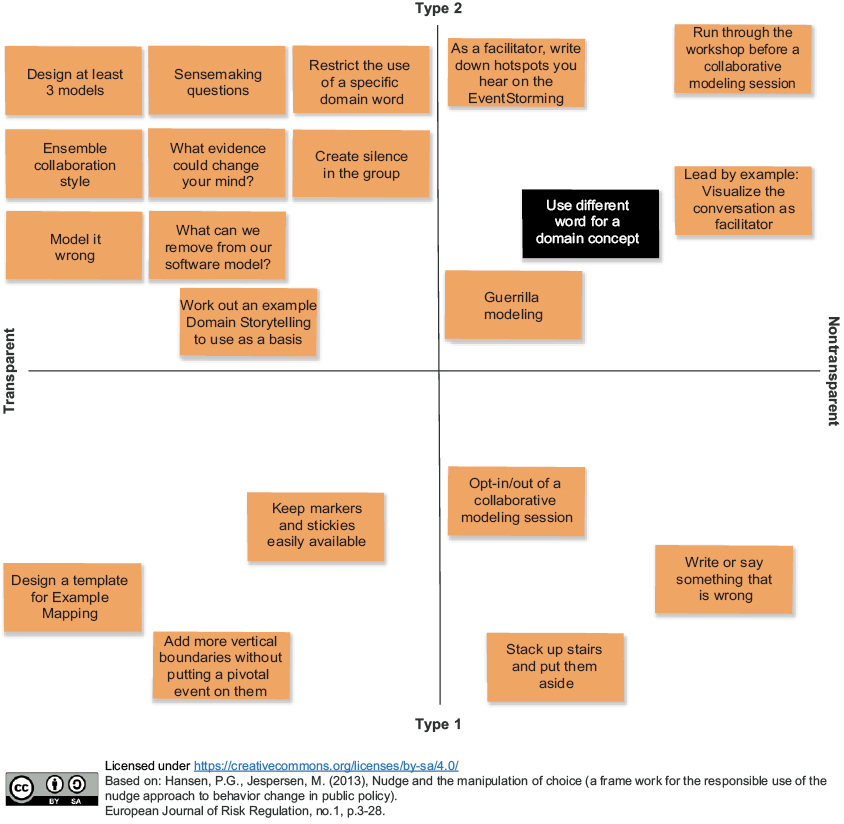
Classify nudges by whether they trigger automatic or reflective thinking and by how transparently people can recognize and consider them. Transparent type II nudges support informed choice; nontransparent type I nudges risk manipulation. section 7.3.3
