A nudge alters a decision environment so people are predictably prompted toward a behavior without losing available choices. It is a trigger, not a mandate: people must be able to avoid it easily and should not feel manipulated. In collaborative modeling, nudges can make productive actions—such as preparing a template or visualizing a discussion—easier to take. section 7.3.2 section 7.7
Use nudges where complexity, time pressure, or group dynamics make cognitive biases more likely. A shared visual template can reduce overload and support more informed discussion; individual note-writing before group discussion can reduce anchoring. Treat the decision environment itself as something that can be designed, including its tools, prompts, examples, language, and starting structure. section 7.3.2 section 7.4 section 7.5
Design an ethical nudge with these checks:
- Keep choice intact. Present the prompt or structure as optional, and seek explicit agreement when the group will use it as a discussion foundation. section 7.3.2
- Choose the thinking mode deliberately. Type 1 nudges affect automatic thinking; type 2 nudges direct attention and invite reflection. section 7.3.3
- Make transparency a design decision. Transparent type 2 nudges tell people what is happening and give them time to consider a response; nontransparent type 1 nudges can become manipulative. section 7.3.3
- Adapt rather than copy. Culture, age, environment, and group context can change how a nudge works. section 7.3.4
- Name the intended effect before the session: define the nudge and what you want it to achieve. section 7.4
Prompting reflection instead of defending a position
When confirmation bias makes one participant seek only supporting evidence and leaves others guarded, ask: “What evidence could change your mind?” This type 2 nudge shifts attention toward reflection. It may open discussion of the session’s benefits and drawbacks, or reveal that the disagreement has become conflict requiring a different response. section 7.3.3
Figure 7.5 An example of the template we created together with the engineering team for use in an Example Mapping session. Although this is a very basic version of a cinema seating arrangement, it can be easily adapted to, for instance, add in a corridor in the middle. Sometimes, a good first example is enough.
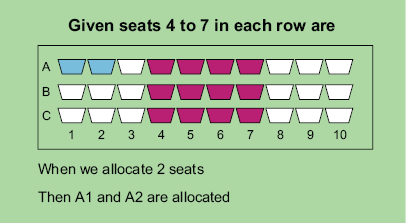
Use the seating template as a starting example of a shared structure: simple enough to begin discussion, but adaptable when a scenario needs details such as a corridor. section 7.3.2
Nudges are not silver bullets. Favor small additions that help people participate, take ownership, or start modeling—for example, showing an example and stepping back, rehearsing with two participants, or ensuring visualization tools are ready. Vary session structures when repetition makes participation less engaging, then refine a local set of heuristics from what works. section 7.3.4 section 7.5
