liveBook · Manning

Decoupling

As explained in Microsoft Azure in Action

Decoupling is an architectural pattern that reduces direct dependencies between software components so they can operate and scale independently.

Decoupling lets services that produce messages and services that process them operate independently. A queue buffers incoming work, so a processor can keep a steady pace even when orders arrive faster during busy periods. section 5.5

Orders during a sales rush

Banning Books adds each website order to a storage queue. A separate process retrieves and handles orders without needing to know which service created them. If retrieval fails, the message remains available. section 5.5

Figure 5.13 Using a Queue Storage for holding orders without overwhelming the order processing
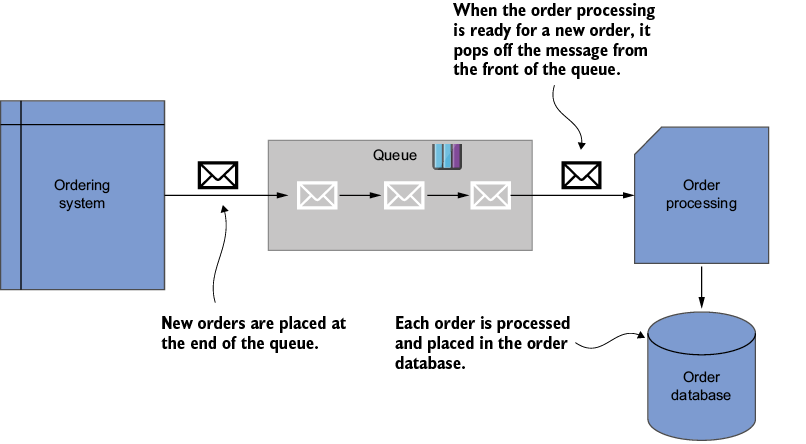
Shows a queue holding orders so processing can continue without being overwhelmed by incoming demand. section 5.5


How Microsoft Azure in Action covers it

How deep it goes
Explains queue-based separation, steady processing, ordered retrieval, and message retention when retrieval fails.
Examples
Uses Banning Books orders queued during busy sales periods for processing by a separate service.
What it assumes
Assumes familiarity with Queue Storage and message storage, then introduces decoupling through an order-processing scenario.
What you can do after
Apply it via Azure Queue Storage to separate order creation from processing and accommodate changing input rates.
How it connects
Connects decoupling with Azure Queue Storage, asynchronous processing, scalability, and producer-consumer services.

Also explained in

Compare how 3 books explain decoupling →

Related concepts

This explainer was generated by Manning's knowledge graph from the text of Microsoft Azure in Action. The section links point to the parts of the book it draws on.
