A deep neural network is a parameterized function approximator. It learns layer-by-layer transformations of raw inputs, rather than relying on hand-designed features, to produce predictions such as action values. section 8.2
In deep reinforcement learning, a network can:
- Process each layer with a weighted sum and bias, followed by a nonlinear activation that lets stacked layers model complex relationships. section 8.2
- Learn useful representations from high-dimensional states and output one Q-value per discrete action. section 8.5
- Update parameters by reducing prediction error, with backpropagation computing gradients through the layers. section 8.2 section 8.6
From raw input to action values
An image or sensor vector can enter the network as a raw state; learned layers transform it before the network estimates Q-values. section 8.2 section 8.5
Figure 8.4 End-to-end learning in deep neural networks
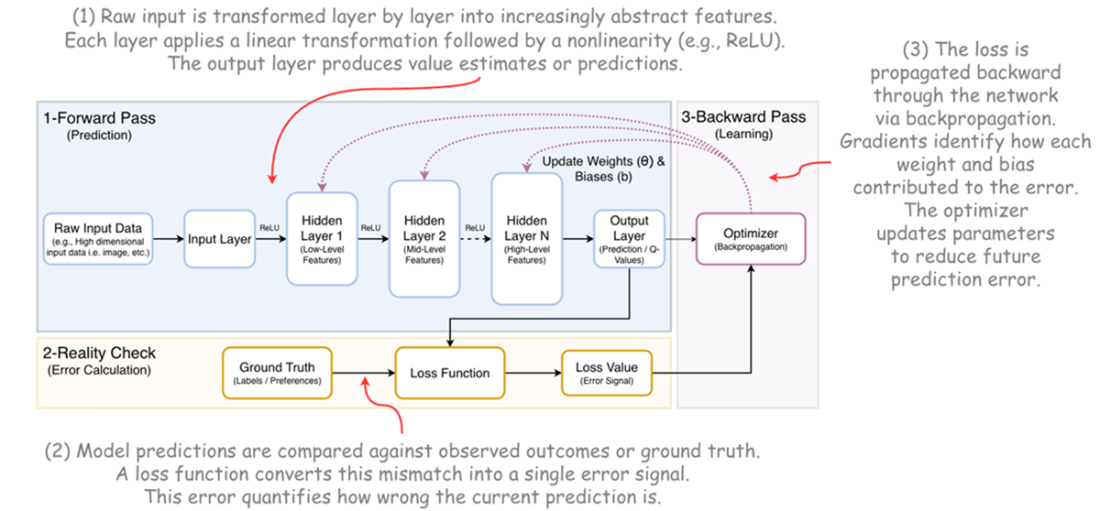
Trace the forward pass, prediction, error, and parameter-update loop. section 8.2
