Large language model
A large language model is a machine-learning model trained on extensive text data to process and generate natural language.
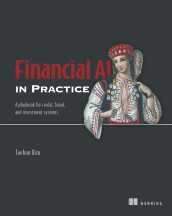
Financial AI in Practice
A large language model is a language model with many learned parameters, typically trained on extensive text data to process or generate language.
- How it is used
- Uses LLMs as language-processing and decision-support components in financial research, credit explanations, fraud investigations, and constrained agent workflows.
- How deep it goes
- Explains probabilistic generation and operational failure modes, then develops application roles and controls without detailing model training internals.
- Examples
- Illustrates a SHAP-based credit explanation and fraud case summaries validated by analysts.
- What you can do after
- Evaluate LLM applications by matching language tasks to grounding, decision boundaries, and human review.
Read how Financial AI in Practice explains large language model →
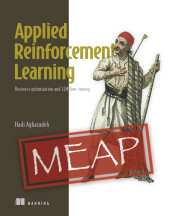
Applied Reinforcement Learning
A machine-learning model trained on large text corpora to model and generate language.
- How it is used
- Uses language models as RL policies for response alignment and as news-to-state representation layers for portfolio agents.
- How deep it goes
- Explains tokenization, transformer flow, RL mapping, and fine-tuning workflow without the full architectural mathematics.
- Examples
- Illustrates response preferences with a mental-health query and structured signal extraction with financial news headlines.
- What you can do after
- Evaluate language-model alignment and representation choices using preference comparisons, state mappings, and multiple response-quality measures.
Read how Applied Reinforcement Learning explains large language model →
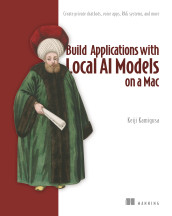
Build Applications with Local AI Models on a Mac
A machine-learning model trained on large amounts of text to process and generate language.
- How it is used
- Uses an LLM as the response generator in a private, voice-enabled local assistant.
- How deep it goes
- Explains training and next-piece prediction in plain language, then traces chat history and streaming through an application.
- Examples
- Uses “Once upon a ...” to illustrate prediction and a voice-enabled chatbot to demonstrate local responses.
- What you can do after
- Apply it via Ollama to run and manage local models and build a streaming chatbot with conversation history.
Read how Build Applications with Local AI Models on a Mac explains large language model →
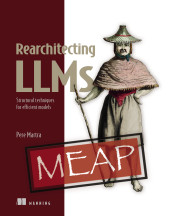
Rearchitecting LLMs
A large language model is a neural language model trained on extensive text data to understand and generate language.
- How it is used
- Frames general-purpose models as starting points for adapting language systems to specialized tasks and deployment constraints.
- How deep it goes
- Defines training scale and capabilities, then motivates architectural adaptation without detailing transformer internals.
- Examples
- Uses financial-document extraction and report generation, plus pharmaceutical workloads used only a few times daily.
- What you can do after
- Evaluate whether a general-purpose model mismatches a task and motivate a smaller specialized alternative.
Read how Rearchitecting LLMs explains large language model →
Claude at Work
A large language model is a machine-learning model trained on extensive text data to generate and interpret natural language.
- How it is used
- Uses LLMs as assistants for parallel coding, testing, documentation, and planning workflows.
- How deep it goes
- Explains next-word prediction and practical limitations without detailing model internals.
- Examples
- Illustrates separate Claude sessions generating code, writing tests, drafting documentation, and planning a project.
- What you can do after
- Evaluate and understand LLM output through critical dialogue, corrections, and human judgment.
Self-Hosting LLMs at Scale
A machine learning model trained on large text collections to understand and generate language.
- How it is used
- Frames LLM deployment as a choice between provider APIs and organization-controlled self-hosting, especially when data control matters.
- How deep it goes
- Defines an LLM and limits deployment examples to text-in/text-out, while noting image and audio inputs without treating them.
- Examples
- Uses a law firm’s confidential client material sent to a public AI tool to motivate controlled deployment.
- What you can do after
- Evaluate whether provider-hosted APIs or self-hosting better fits organizational data-control needs.
Read how Self-Hosting LLMs at Scale explains large language model →
Also covered in
- Build a Multi-Agent System (from Scratch)In early access (MEAP)
- The Architecture of ReasoningIn early access (MEAP)
- Context EngineeringIn early access (MEAP)
- LLM Customization and Fine-TuningIn early access (MEAP)
- Vanilla WebIn early access (MEAP)
- Systems Programming with ZigIn early access (MEAP)
- Building Distributed Applications that Work
- Grokking Software ArchitectureIn early access (MEAP)
What to know first
- artificial intelligenceArtificial intelligence is the field of computing concerned with creating systems that perform tasks associated with intelligence, such as learning, reasoning, perception, and decision-making.
- AI agentAn AI agent is a computational system that uses artificial intelligence to interpret information and select or perform actions toward goals while interacting with an environment.
- neural networkA neural network is a computational model composed of interconnected, parameterized units or transformations that learn to map inputs to outputs.
- foundation modelA foundation model is a broadly trained machine-learning model whose learned capabilities can be reused or adapted for a range of downstream tasks.
Related concepts
- retrieval-augmented generationused by · Retrieval-augmented generation is a technique that retrieves relevant information from external sources and supplies it as context to a generative model when producing an output.
- context windowuses · A context window is a bounded span of sequence elements or contextual information that a model or processing operation can consider together.
- LLM-as-a-judgeused by · LLM-as-a-judge is an evaluation technique in which a language model assesses or compares outputs according to specified criteria.
- next-word predictionuses · Next-token prediction is a language-modeling task or objective in which a model predicts the token that follows a given context.
- Ollamaused by · Ollama is software for downloading, managing, running, and serving language models locally.
- reasoning modelincludes · A reasoning model is a machine-learning model designed or trained to perform multistep analysis or inference before producing an answer or result.
Questions about large language model
What is large language model?
A large language model is a machine-learning model trained on extensive text data to process and generate natural language.
Which Manning books explain large language model?
Financial AI in Practice, Applied Reinforcement Learning, Build Applications with Local AI Models on a Mac, Rearchitecting LLMs, Claude at Work and Self-Hosting LLMs at Scale.
What should I know before learning large language model?
Manning books that teach large language model usually introduce artificial intelligence, AI agent, neural network and foundation model first.
What kinds of large language model are there?
Kinds of large language model include reasoning model.
What is large language model also called?
Large language model is also called LLMs.
These guides are generated from the text of Manning books by Manning's knowledge graph and link to the sections they draw on. The full books are available on liveBook and at manning.com.