A portfolio team may need to read hundreds of news reports before deciding what deserves attention. A large language model (LLM) can synthesize that language and turn market narratives into structured signals for review. It is a probabilistic generator, not a database: a plausible answer may contain an invented fact, a wrong number, or an outdated claim. section 11.0 section 11.1.1
Put the LLM inside a controlled financial workflow:
- Choose the job. Use it for unstructured reports, news, case files, or explanations; retain specialized models for structured numerical prediction and risk scoring. section 3.1.3 section 7.4.3
- Supply trustworthy context. Retrieval-Augmented Generation (RAG) can provide relevant documents, but weak ingestion or retrieval can still produce wrong answers. section 3.1.3
- Constrain and review the output. Feed the model verified scores or indicators, require recommendations within explicit bounds, and keep people responsible for consequential decisions. section 6.5 section 12.0
Explain a credit result without changing it
A deterministic credit model assigns a negative contribution to high credit utilization. A constrained LLM turns that result into a readable explanation for the applicant. The scoring model and its interpretability output remain the source of truth; the LLM must not calculate the score or invent a rejection reason. section 6.5
The role can expand from extracting sentiment in financial news to interpreting structured macroeconomic indicators for a portfolio manager. That shift supports auditable decision advice, not autonomous trading or proof of predictive returns. Monitor data quality, information timing, model variability, and human approval as parts of the application—not as properties of the LLM alone. section 12.0 section 12.1.4
Figure 14.1 The four-layer framework extended for agentic systems. The fundamental structure remains intact, but each layer’s implementation changes. The data asset layer now exposes data through callable tools. The modeling layer expands from traditional ML to include LLM-based reasoning. The application layer becomes an agent executor rather than a simple API. The strategy and monitoring layer adds HITL governance alongside traditional metrics.
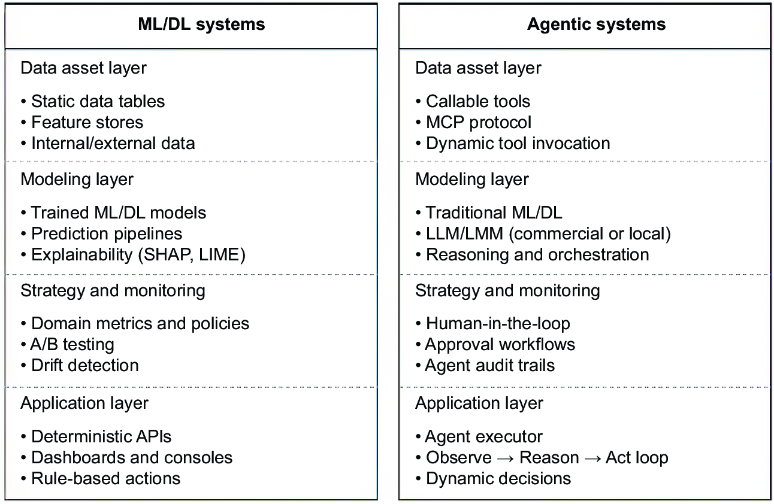
The four-layer diagram places LLM reasoning in the modeling layer, alongside callable data tools, an agent executor, and human-in-the-loop governance. section 14.1.2

