A degenerate triangle has zero area. Its three vertices still appear as a triangle in data, but its geometry collapses into a segment, making it a troublesome special case in programming and geometric modeling. section 2.2.2
Recognize the two common forms:
- Needle: two vertices coincide, producing a sharp end and an overlapping pair of vertices. section 2.2.2
- Cap: three distinct vertices lie on one line, so the triangle is flattened into a segment-like shape. section 2.2.2
- Both forms can damage a triangle mesh’s topology: the intended relationships among triangles, edges, and neighbors no longer behave normally. section 2.2.2
Checking triangle quality
A useful quality metric should report a degenerate triangle as horrible and an equilateral triangle as excellent. The Rin/Rout metric decreases as a triangle approaches degeneracy, providing a practical signal for identifying poor geometry. section 2.7 section 2.2.2
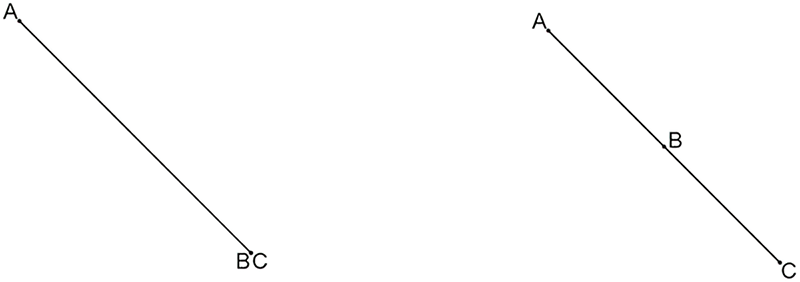
Compare needles and caps visually before reasoning about their different vertex configurations. section 2.2.2
