liveBook · Manning

Near-degenerate triangle

As explained in Geometry for Programmers

A nonzero-area triangle whose extreme thinness makes geometric computations numerically error-prone.

A near-degenerate triangle has nonzero area but is so thin that geometric operations become error-prone. Because no single formal definition exists, triangle quality is often estimated with the Rin/Rout metric: the incircle radius divided by the circumcircle radius. Equilateral triangles score best; increasingly thin triangles approach zero. section 2.2.2

Use the metric as a practical mesh-cleaning rule:

  • Compute or assess the ratio between the inscribed-circle and circumscribed-circle radii. section 2.2.2
  • Choose a small application-specific threshold and filter triangles below it, including strictly degenerate triangles whose ratio is zero. section 2.2.2
  • Clean these triangles before compound mesh operations, trading some geometric detail for simpler and more reliable processing. section 2.2.2
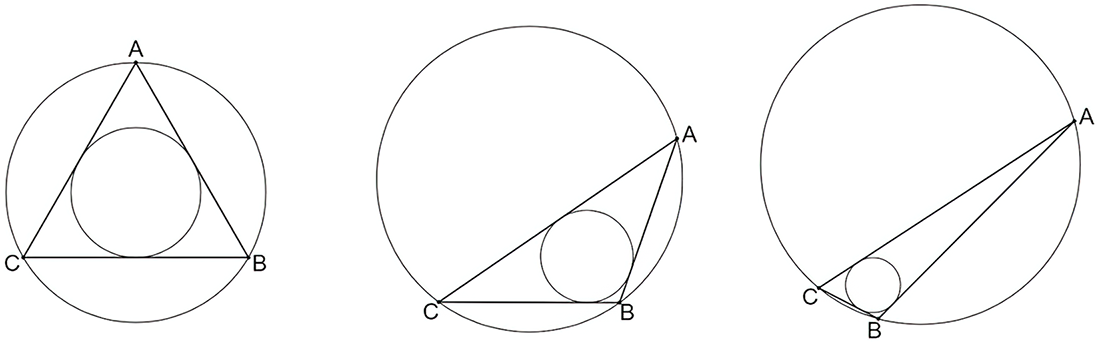
Figure 2.14 The Rin/Rout metric gets smaller as a triangle heads to the degenerate state.
02-14

Use the figure to see how the Rin/Rout metric decreases as a triangle approaches degeneracy. section 2.2.2

How Geometry for Programmers covers it

How deep it goes
Defines the problem, explains incircle and circumcircle geometry, and stops short of prescribing a universal quality threshold.
Examples
Uses equilateral, increasingly thin, and strictly degenerate triangles to illustrate decreasing Rin/Rout values.
What you can do after
Diagnose and filter problematic triangles using the Rin/Rout metric and a chosen small threshold.
How it connects
Connects triangle quality with degenerate triangles, mesh processing, incircles, and circumcircles.

Related concepts

This explainer was generated by Manning's knowledge graph from the text of Geometry for Programmers. The section links point to the parts of the book it draws on.