A delegative system makes decisions for users when case-by-case human control is impractical because decisions require overwhelming data or rapid response. It preserves human review, correction, and intervention when automated behavior fails. section 9.2.2
Choose delegation deliberately because it changes functional and nonfunctional requirements. Production delivery must provide suitable data flows, model serving, user controls, instrumentation, logging, monitoring, alerting, testing, sign-off, and ethical review. section 9.11
Perseverance rover
The rover independently proposes a terrain path, sends it to Mission Control for approval, prepares the command process, and executes the approved plan. This balances communication latency against the risk of full autonomy: manual control would be too slow, while complete autonomy would expose the mission to unacceptable risk. section 9.2.2
Figure 9.3 The control flow for a delegative remote control rover [1]
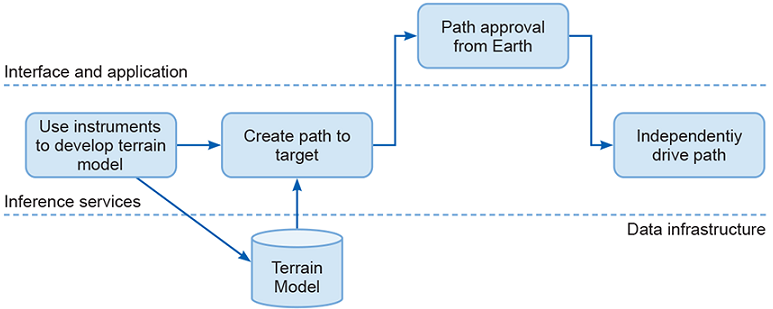
Use the control-flow diagram to trace how independent planning is separated from human approval and execution. section 9.2.2
