liveBook · Manning

Demilitarized zone

As explained in Acing the CCNA Exam: Volume 2 Advanced Networking and Security

A demilitarized zone is an isolated network segment for systems that must be reachable from untrusted networks while limiting exposure of internal hosts.

A demilitarized zone (DMZ) is an isolated network segment for servers that must accept connections from the public internet. Separating these systems from the Inside zone limits exposure if a publicly reachable server is compromised. section 11.5.1

Apply the concept through firewall zones and traffic policy:

  • Place internet-facing servers in the DMZ rather than the Inside zone. section 11.5.1
  • Use firewall policies to control traffic between the Outside, DMZ, and Inside zones. section 11.6
  • Treat the DMZ as a security boundary, not as unrestricted access to internal hosts. section 11.5.1
Figure 11.11 Servers that need to accept connections from the internet can be placed in the DMZ without compromising the security of hosts in the Inside zone.
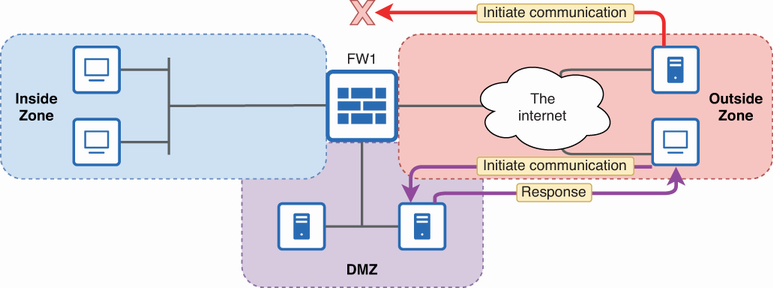
Diagram the placement of internet-facing servers in the DMZ while keeping Inside-zone hosts protected. section 11.5.1


How Acing the CCNA Exam: Volume 2 Advanced Networking and Security covers it

How deep it goes
Explains DMZ placement and inter-zone policy relationships without detailing device-specific configuration.
Examples
Uses public-facing servers as the concrete example of systems placed in a DMZ.
What you can do after
Evaluate network layouts by identifying which internet-reachable servers belong in a DMZ rather than the Inside zone.
How it connects
Connects DMZs with stateful firewalls, security zones, ACLs, and Inside and Outside network segments.

Also explained in

Compare how 2 books explain demilitarized zone →

Related concepts

This explainer was generated by Manning's knowledge graph from the text of Acing the CCNA Exam: Volume 2 Advanced Networking and Security. The section links point to the parts of the book it draws on.