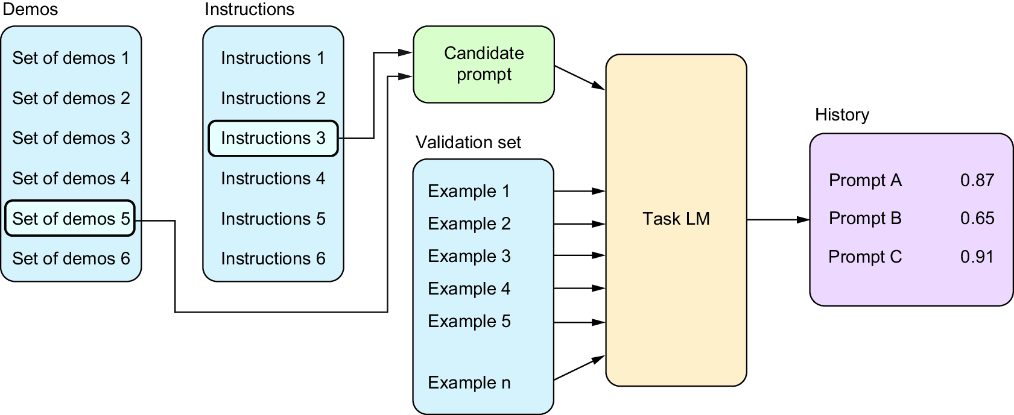
A demonstration set is a collection of task examples paired with a language-model instruction. MIPROv2 builds candidate sets by repeatedly selecting examples from training data, including an empty set for zero-shot prompting. It then searches combinations of demonstration sets and candidate instructions, using Bayesian optimization to choose which combinations to test. section 6.2
Figure 6.2 The MIPROv2 algorithm step 3. In steps 1 and 2, we create the candidate sets of demos and candidate instructions. In step 3, we try various ways to combine them until we find the combination that performs best. Because there are often many combinations, this step uses a Bayesian optimization method to determine which combinations to try. In this example, we try set of demos #5 and instructions #3, creating a prompt that is tested on all or part of the validation set with the task LM. The score is recorded, allowing us to track which sets of demos work well, which instructions work well, and which work well together. This helps us determine which other combinations to test in subsequent iterations.
See how candidate demonstration sets and instructions are combined, tested, and scored. section 6.2
