A denial-of-service attack overwhelms a model-serving system with requests, interrupting authorized access or consuming shared computational resources needed by other services. The cause may be malicious, accidental, or a client misconfiguration. section 4.4.2
A practical defense uses rate limiting to control request pressure:
- Place incoming model-serving requests in a queue. section 4.4.2
- Process only the number of concurrent requests allowed by the current limit. section 4.4.2
- Continue with queued requests after active requests finish. section 4.4.2
Two-request concurrency limit
Four requests arrive, but a limit of two concurrent requests admits only two initially; the remaining requests wait until capacity becomes available. section 4.4.2
Figure 4.17 A flowchart of four model serving requests sent to the model serving system. However, only two are under the current rate limit, which allows a maximum of two concurrent model serving requests. Once the system has finished processing those two requests, it will proceed to the remaining two requests in the queue.
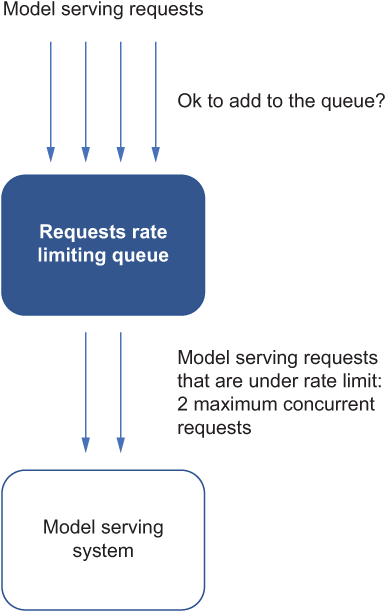
Visualizes how a rate-limiting queue admits requests in bounded groups and releases queued work as processing completes. section 4.4.2



