A DHCP exhaustion attack, also called DHCP starvation, is a denial-of-service technique that prevents legitimate clients from receiving IP addresses. The attacker sends countless DHCP DISCOVER messages while spoofing the source MAC address in each request, consuming the DHCP server’s address pool. section 11.2.1 section 11.6
Recognize the attack by its traffic pattern and effect:
- Generates repeated DHCP DISCOVER messages with spoofed MAC addresses. section 11.2.1
- Exhausts the DHCP server’s available address pool. section 11.2.1
- Denies service because legitimate user devices cannot obtain IP addresses. section 11.2.1 section 11.6
- Combines spoofing with a DoS objective; it is not described as a DDoS attack unless multiple infected devices perform the attack. section 11.2.1
Figure 11.3 A DHCP exhaustion attack. The attacker sends countless DHCP DISCOVER messages with spoofed MAC addresses, exhausting the target DHCP server’s pool. As a result, legitimate user devices cannot receive IP addresses.
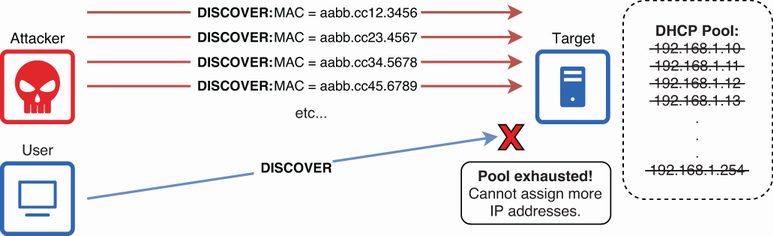
Visualizes spoofed DHCP DISCOVER messages exhausting the target server’s pool and blocking legitimate address allocation. section 11.2.1
