A DHCP poisoning attack uses a rogue DHCP server to provide valid IP leases while naming itself as the client’s default gateway. The attacker can then intercept and potentially alter traffic before relaying it to the legitimate router. section 13.1
The attack depends on these operational conditions:
- Clients commonly accept the first DHCP OFFER, so the rogue server races the legitimate server or benefits from lower latency. section 13.1
- Port Security does not stop the attack because the rogue server can send DHCP messages from one MAC address. section 13.1
- DHCP Snooping blocks server messages arriving on untrusted ports; trust ports facing DHCP servers and leave host-facing ports untrusted. section 13.3
Defensive switch configuration
Enable DHCP Snooping globally and for each VLAN with ip dhcp snooping and ip dhcp snooping vlan vlans. Configure legitimate server-facing interfaces with ip dhcp snooping trust, then verify using show ip dhcp snooping. section 13.3
Figure 13.1 A DHCP poisoning attack. The rogue DHCP server replies to PC1’s DHCP messages, assigning it an IP address and telling it to use the rogue server as its default gateway. The rogue server then intercepts PC1’s communications.
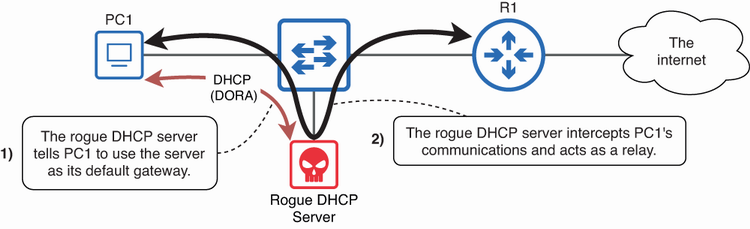
Shows a rogue DHCP server assigning a client an address and itself as the default gateway, enabling traffic interception. section 13.1
