A denoising autoencoder reconstructs clean data from a corrupted version. Noise enters the encoder, while the reconstruction loss compares the decoder output with the original clean input, preventing simple copying and encouraging robust representations. section 7.4
A practical implementation follows this pattern:
- Generate realistic perturbations from clean training examples; better-matched noise generally produces more useful denoising. section 7.4
- Add Gaussian noise only during training with an AdditiveGaussNoise layer, then leave inputs unchanged during evaluation. section 7.4.1
- Use dropout as an alternative perturbation, typically dropping 5–20% of input values and retaining the usual reconstruction training loop. section 7.4.1
Digit reconstruction and real-world noise
A widened autoencoder reconstructs handwritten digits from clean, Gaussian-corrupted, or dropout-corrupted inputs. It preserves most digit style but can lose small flourishes, such as details on the 4 and 5. The same strategy supports fingerprint recognition and OCR when synthetic noise resembles camera, document, lighting, or shadow damage. section 7.4 section 7.4.1
Figure 7.5 The denoising autoencoder processes applied to fingerprint images. This used special software that generates hyper-realistic fingerprint images, with the goal of removing that noise to make fingerprint processing less error prone. You can still get good results with simpler and unrealistic noise.
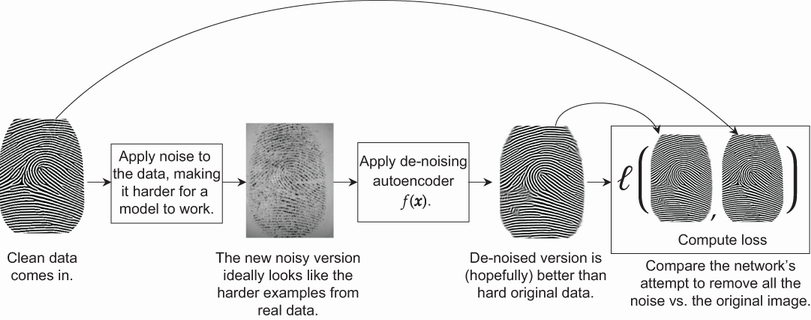
Shows the complete pipeline from clean fingerprint data through realistic corruption to clean reconstruction. section 7.4
The same analogy extends from images to sequence-to-sequence learning: an encoder RNN maps an input sequence to a representation, and a decoder RNN produces a related clean sequence that may differ in content and length. section 11.1

