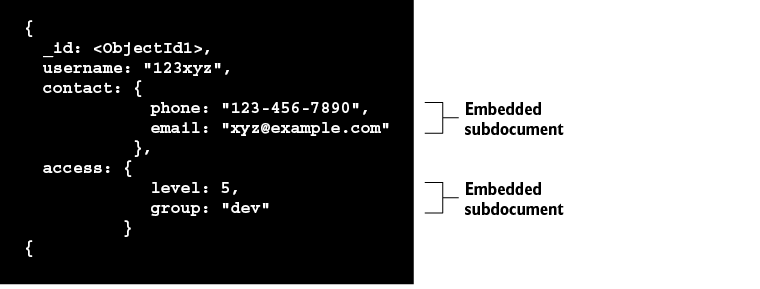
A denormalized data model stores related data together or redundantly to reduce the need for joins, separate queries, or cross-record operations.
Denormalization stores related data together, often by embedding it in one MongoDB document. This can reduce queries for routine operations and let related data be read or updated in a single operation. section 5.2
Consider embedding when:
One entity contains another, or child records are usually accessed with their parent. section 5.2
Related information is frequently accessed independently, duplication is not worthwhile, or the relationship is complex and many-to-many, consider separate documents and references instead. section 5.2
Avoid bloated documents: embedded data may be unused together and documents must remain below MongoDB’s 16 MB BSON limit. section 5.2
Treat denormalization as a schema-design choice, not a replacement for every join or distributed transaction; joins can be resource-intensive, and distributed transactions can cost more than single-document writes. section 8.4.3section 6.2.2
ScyllaDB in ActionDenormalization is a data-modeling technique that stores related data together, often duplicating information to support access patterns without additional lookups.
Microsoft Azure in ActionDenormalization is the intentional introduction of redundant or combined data into a relational schema to improve read performance or simplify access.
Grokking Relational Database DesignDenormalization is the deliberate introduction of controlled redundancy or less-normalized database structures to improve performance or meet operational needs.
Effective Data AnalysisDenormalization is the deliberate combination or duplication of related data to reduce separation between tables and simplify analytical access.
Building Web APIs with ASP.NET CoreDenormalization is the deliberate combination or duplication of related data to simplify retrieval or improve access performance.
normalizationcontrasts with · Normalization is the process of transforming a value, representation, or data structure to satisfy a specified standard, scale, or structural constraint.
database normalizationcontrasts with · Database normalization is a relational database design technique that organizes data into related tables to reduce redundancy and prevent update or dependency anomalies.
joinaddresses · A join is an operation that combines records or rows from multiple data sources according to specified matching conditions or relationships.
redundancyproduces · Redundancy is the presence of duplicate or overlapping information, components, or resources, whether intentional or unnecessary.
optimizationkind of · Optimization is the systematic selection or adjustment of values, actions, or system designs to improve a specified objective, often subject to constraints.
This explainer was generated by Manning's knowledge graph from the text of MongoDB 8.0 in Action, Third Edition. The section links point to the parts of the book it draws on.