Dependency injection decouples high-level infrastructure resources from low-level dependencies. High-level resources request low-level attributes through an abstraction instead of constructing or binding directly to them. The pattern combines inversion of control with dependency inversion, allowing network changes to evolve without disrupting servers, queues, applications, or databases. section 4.2 section 4.2.3
Apply dependency injection through these infrastructure practices:
- Use an infrastructure API or state as an abstraction layer; the high-level resource retrieves and parses the metadata it needs. section 4.2.3
- Start with a facade when one low-level module serves a few high-level modules; use an adapter for many consumers or heterogeneous providers, and a mediator for many interdependent resources. section 4.6
- Preserve idempotency, composability, and evolvability while isolating changes between modules and resources. section 4.6
Server and network
A server uses Apache Libcloud to query the GCP API for a subnet name, parse the returned metadata, and assign itself the fifth IP address in the network range. After the network range changes, the network is deployed first; the server retrieves the new metadata and recalculates its address without changing its own configuration logic. section 4.2.3
Infrastructure facades and mediators
A storage-bucket module outputs bucket attributes for an access-control module, exposing a simplified interface while keeping the bucket implementation independent. When a firewall depends on both a server and a network, a mediator creates the network first, the server second, and the firewall third; it can also organize deletion. section 4.3 section 4.5
Dependency injection also supports refactoring monolithic IaC. Extract independent resources first, separate their configuration and state, then update dependent resources to retrieve low-level identifiers through the provider API. Test each isolated component and repeat the workflow toward lower-level resources, minimizing disruption and preserving resource state. section 10.2.3 section 10.3
Figure 4.6 Dependency injection combines inversion of control and dependency inversion to loosen infrastructure dependencies and isolate low-level and high-level resources.
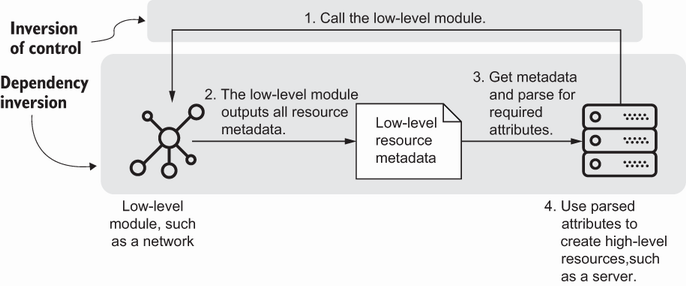
Use the dependency diagram to see how inversion of control and dependency inversion form an abstraction buffer between high- and low-level infrastructure resources. section 4.2.3




















