Deployment frequency measures how often an organization successfully releases software to customers. It is a DORA software-delivery metric associated with team velocity. Tracking it can help assess whether platform changes improve continuous delivery. section 9.1
A Kubernetes-based calculation can follow three stages:
- Collect Kubernetes deployment-related Events through a Knative Eventing APIServerSource, convert them to CloudEvents, and store them. section 9.2.4 section 9.2.2
- Map relevant CloudEvents to CDEvents. One example maps an API-server resource-add event involving a Deployment to dev.cdevents.service.deployed.0.1.0. section 9.2.5
- Read service-deployed CDEvents, persist each deployment’s service name, timestamp, and deployment name, then calculate counts by service per day, week, or month. Make recalculation idempotent. section 9.2.6
Choose the event mapping to match what you intend to count. Kubernetes internal Events are one input; ArgoCD or Tekton Pipeline events are alternatives. A resource-add event is the example’s counting signal, while the DORA definition concerns successful releases in front of customers. section 9.2.5 section 9.1
Daily counts
A working pipeline uses Knative Serving, Knative Eventing, and PostgreSQL to collect events, transform them, and calculate deployment frequency. Its daily endpoint returns records with a deployment name, count, and date; one sample response reports counts of three and one for two deployments on the same day. section 9.2.7
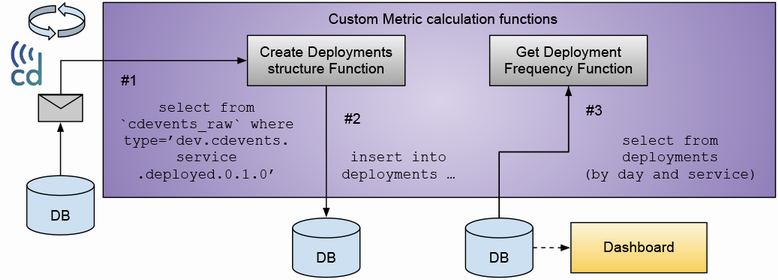
Follow the deployment-frequency calculation from service-deployed CDEvents through stored deployment records to time-bucketed results. section 9.2.6
Keptn Lifecycle Toolkit offers a complementary way to observe deployment activity and begin measuring early platform initiatives. section 9.3


