A derivative root is an input value where a function’s derivative equals zero. Because the derivative measures whether a function rises or falls, this value identifies a possible bump, local maximum, or local minimum. section 6.1.2
A cubic example
For P(x) = x³ − x² − 2x + 1, differentiation gives P′(x) = 3x² − 2x − 2. The roots of this quadratic identify places where the cubic can have bumps. A local minimum occurs when the derivative changes from negative to positive; a local maximum occurs when it changes from positive to negative. section 6.1.2
Use derivative roots to interpret a graph:
- A positive derivative indicates that the function is increasing. section 6.1.2
- A negative derivative indicates that the function is decreasing. section 6.1.2
- A zero derivative is not automatically an extremum; the derivative must change sign around the root. section 6.1.2
Figure 6.5 A cubic polynomial (two bumps, three roots) and its derivative, which is a quadratic polynomial (two roots)
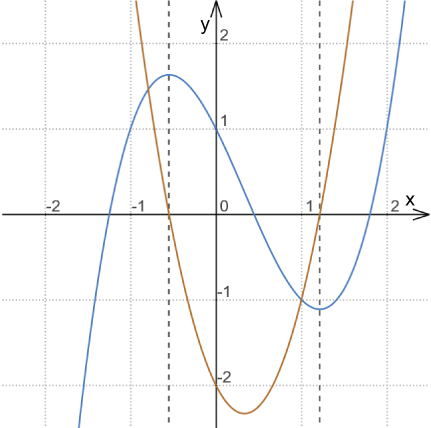
Compare a cubic with its quadratic derivative: two derivative roots correspond to the cubic’s two bumps. section 6.1.2
