An extremum is a local or global minimum or maximum. A local minimum marks a change from decreasing to increasing; a local maximum marks the reverse. A global extremum is also the highest or lowest value of the entire function. section 6.1.2
A local extremum usually coincides with a root of the derivative: the derivative changes sign as the function changes direction. Finding derivative roots is useful, but not sufficient— a function can stop growing or declining without forming a true bump. section 6.1.2
Extrema matter when interpreting polynomial behavior:
- An M-degree polynomial has an (M−1)-degree derivative, so its derivative can reveal where the polynomial may turn. section 6.1.2
- An (N−1)-degree interpolating polynomial can have up to N−2 extrema, producing uncontrolled bumps as more data points increase its degree. section 6.3.2
- These oscillations contribute to Runge’s phenomenon, especially near interpolation-interval ends, limiting polynomial interpolation for large data sets. section 6.3.2
Figure 6.5 A cubic polynomial (two bumps, three roots) and its derivative, which is a quadratic polynomial (two roots)
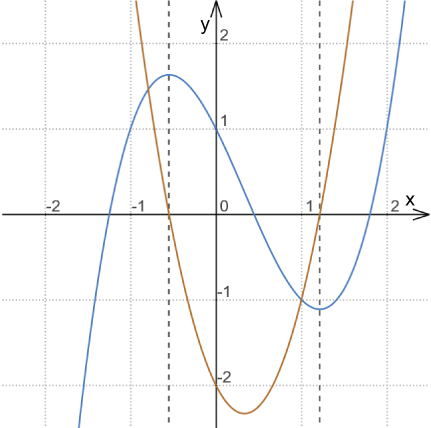
A cubic polynomial and its quadratic derivative illustrate how two derivative roots correspond to two visible bumps. section 6.1.2
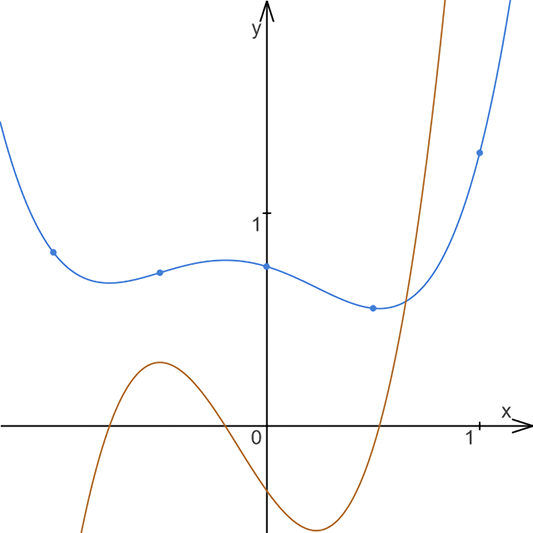
The figure visualizes the possible N−2 extrema of an (N−1)-degree interpolating polynomial. section 6.3.2
