A Rust derive attribute asks the compiler or a procedural macro to add functionality to a struct, enum, or union. The annotated type remains unchanged; generated functions or trait implementations are added alongside it. section 1.3.1
Use derive attributes when the generated behavior is repetitive, predictable, and easy to understand:
- Add standard capabilities such as Debug, Clone, Default, or PartialEq with an annotation such as #[derive(Clone)]. section 1.3.2
- Extend a type without modifying its definition or unrelated application code; derive macros are additive rather than transformative. section 1.3.1
- Prefer derives over custom generation when the intent is immediately recognizable, because opaque or excessive generation can make code harder to understand. section 1.3.2
Building a custom Hello derive
Create a procedural-macro library and mark it with proc-macro = true. Define #[proc_macro_derive(Hello)] in lib.rs, then depend on that library from an application and write #[derive(Hello)] above a struct. A minimal setup uses Cargo, quote, syn, and a separate application crate; the macro can initially return an empty token stream before generating a Hello, World method. section 3.1
Figure 1.2 The types of macros in Rust
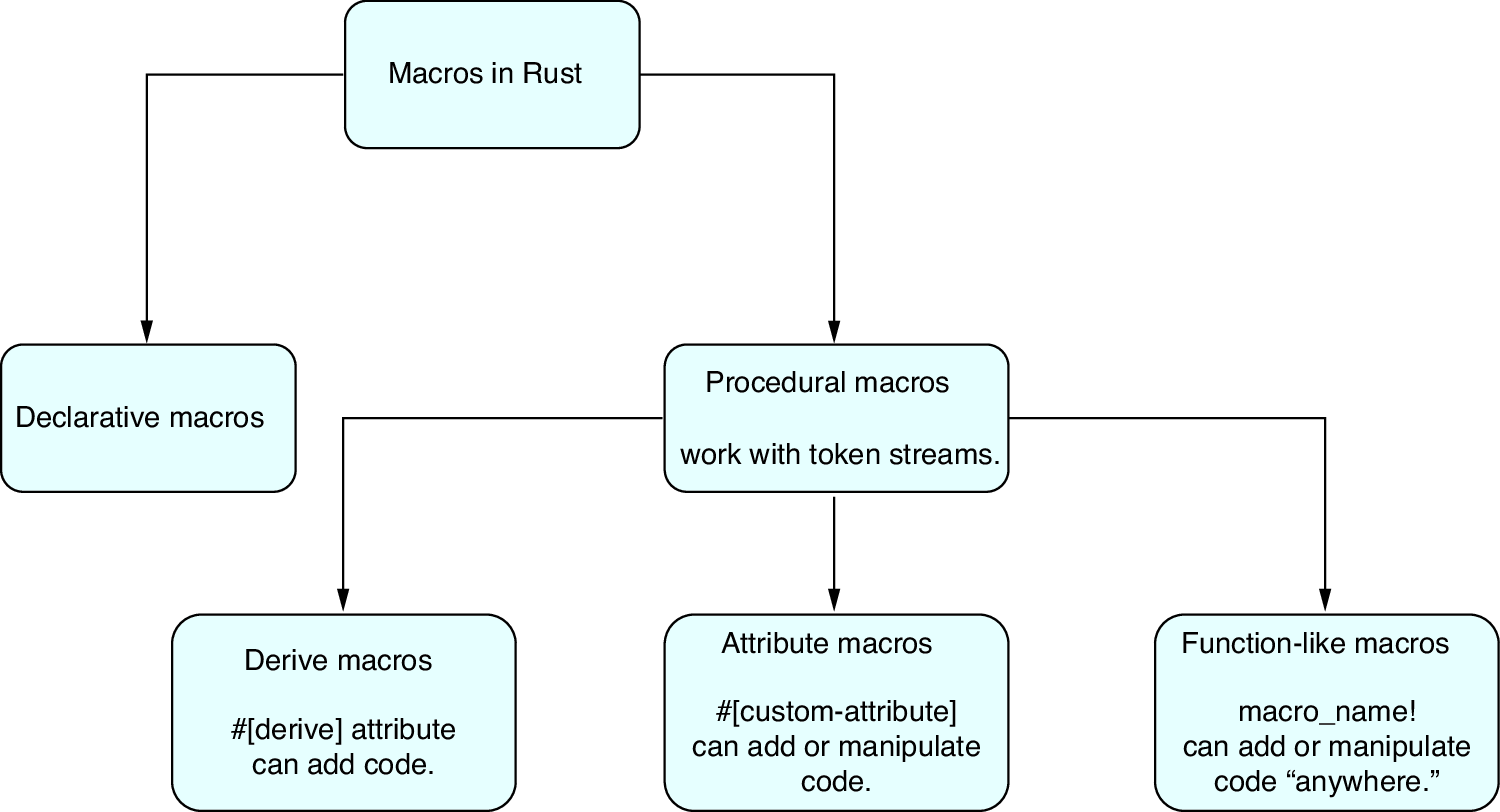
Compare derive macros with attribute and function-like procedural macros through the macro taxonomy. section 1.3.1




