A descendant of a node X is any node reachable through a causal path beginning at X: X → … → Z. In the graph X → M → Z1 ← C → Z2 ← Y, both M and Z1 are descendants of X, while Z2 is not. section 7.1.6
Descendants matter because they lie downstream of a treatment or cause. They cannot be confounders, and conditioning on them can block part of X’s causal effect. A descendant of a collider can also transmit information about that collider and open an otherwise closed path. section 7.1.6 section 7.2
Use descendant status as a practical adjustment check:
- Exclude descendants of X when selecting variables for the back-door criterion; otherwise, adjustment may remove causal paths. section 7.2
- Treat descendants of colliders cautiously: conditioning on one may open a path between variables that was previously blocked. section 7.1.6
- Do not treat every post-treatment variable as a valid control; conditioning on it may induce selection bias or reduce the estimated causal effect. section 7.3.3
Treatment and return to work
Suppose X is a drug treatment, Y is recovery time, and Z is the number of days until a patient returns to work. If Z is downstream of treatment, analyzing only patients who returned quickly can make the drug appear more effective than it is for the full population. section 7.3.3
Figure 7.14 Conditioning on a descendant (Z2) of a collider (Z1) can open new correlations (between M and N).
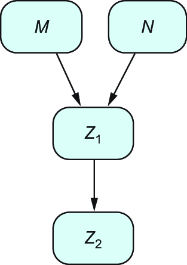
Trace how conditioning on Z2, a descendant of collider Z1, can open a new correlation between M and N. section 7.1.6