A design problem seeks an optimal or near-optimal solution when solution quality matters more than computation time. It is typically solved offline, often once or infrequently, and may justify waiting days for a result. section 1.2 section 2.1.5
Distinguish design problems from other optimization contexts by the time allowed and the quality expected:
- Design problems favor optimality and can tolerate long searches, unlike planning problems, which must finish within seconds or minutes. section 1.2 section 2.1.5
- Control problems prioritize rapid repeated solutions, accepting reduced optimality because corrections can occur during later cycles. section 1.2 section 2.1.5
- Typical applications include vehicle design, class scheduling, asset allocation, resource planning, inventory management, flight scheduling, and assembly-line balancing. section 2.1.5
Districting as a design problem
Political districting groups basic geographic units into larger districts. A high-quality solution may balance population or workload, preserve contiguity, produce compact shapes, respect boundaries, and represent socioeconomic differences. Because the optimization can run offline, substantial search time can be exchanged for better districts. section 2.1.5
Figure 2.12 Qualities of solutions vs. search time. Some types of problems require fast computations but do not require incredibly accurate results, while others (such as design problems) allow more processing time in return for higher accuracy.
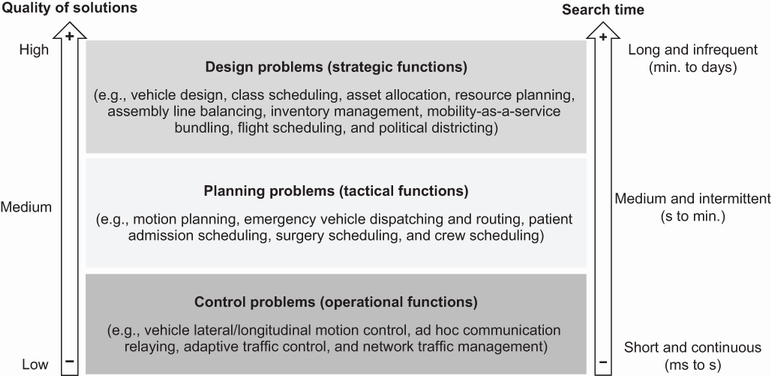
Compare design, planning, and control problems by relating the expected quality of a solution to the time available for search. section 2.1.5
