A strategic function is a design-oriented decision problem where solution quality matters more than response time. It can run offline, perhaps for days, when an optimal or near-optimal result justifies extended computation. section 1.2 section 2.1.5
Recognize strategic functions by their design scope and long optimization horizon:
- Design vehicles, schedules, asset allocations, resource plans, assembly lines, inventories, flights, or political districts. section 2.1.5
- Optimize once or infrequently rather than repeatedly during live operation. section 2.1.5
- Prefer accuracy and solution quality over the rapid responses required by tactical or operational functions. section 1.2 section 2.1.5
Political districting
Political districting groups basic geographic units into acceptable districts. A strategic formulation can balance demographics or workload, preserve contiguity, favor compact shapes, respect boundaries, and support socio-economic heterogeneity. section 2.1.5
Figure 2.12 Qualities of solutions vs. search time. Some types of problems require fast computations but do not require incredibly accurate results, while others (such as design problems) allow more processing time in return for higher accuracy.
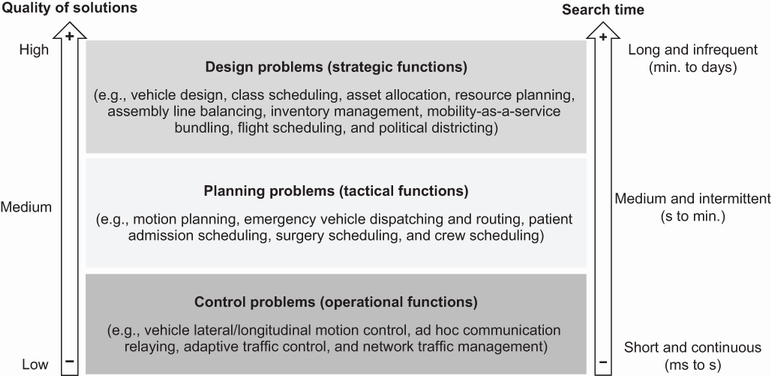
Compare strategic, tactical, and operational functions by permitted search time and expected solution quality. section 2.1.5
