Designated port selection is the STP step that chooses one forwarding port for each network segment, helping create a loop-free topology. Each segment has exactly one designated port; other competing ports become non-designated and are blocked. section 14.3 section 14.3.3
Apply the selection rules in this order:
- Choose the port on the switch with the lowest root cost. section 14.3.3
- If root costs tie, choose the port on the switch with the lowest bridge ID (BID). section 14.3.3
- Remember that BPDUs are sent only through designated ports; root-bridge ports are designated, as are ports connected to root ports. section 14.3.3
Comparing two connected switches
When SW1 has root cost 4 and SW2 has root cost 8, SW1 G0/3 becomes designated and SW2 G0/0 becomes non-designated. If root costs tie, compare BIDs: SW4’s lower BID makes SW4 G0/1 designated. section 14.3.3
Figure 14.13 Each segment must have exactly one designated port. All ports on the root bridge are designated, and so are all ports connected to a root port. One designated port is selected on each remaining segment, and the remaining ports are non-designated.
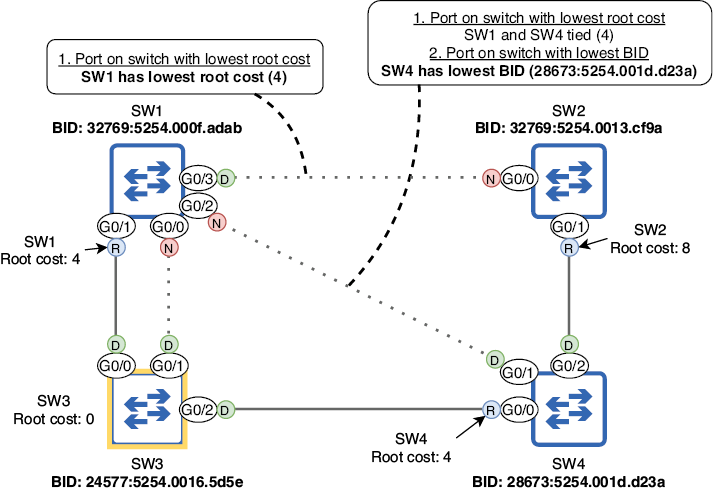
Use the topology figure to identify the single designated port on each segment and distinguish blocked non-designated ports. section 14.3.3
