liveBook · Manning

Detection

As explained in Machine Learning Platform Engineering

Hallucination detection is the identification of generated claims that are fabricated, unsupported, or absent from trusted context.

Hallucination detection identifies generated claims that may be fabricated or unsupported, using factuality and source-grounding validators within a broader safety pipeline. section 13.3.1

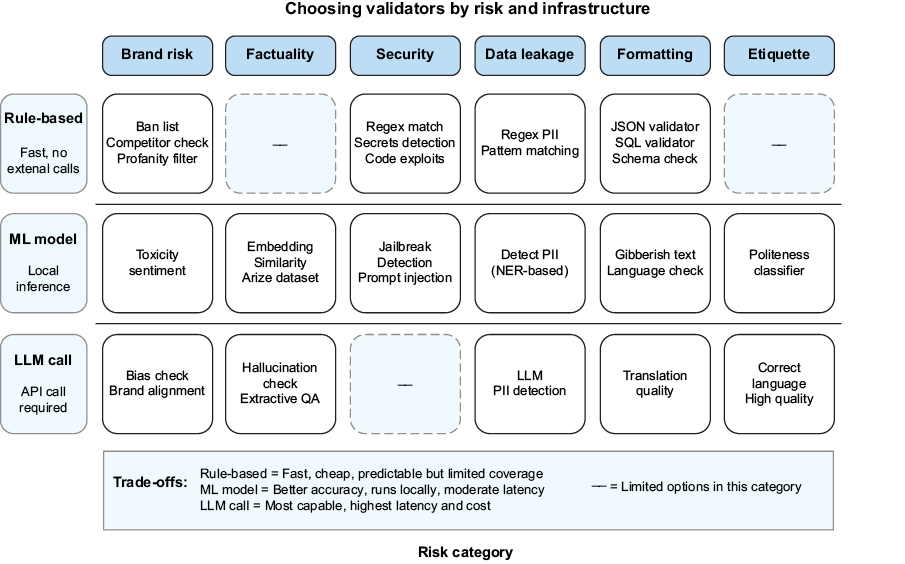
Choose the validation approach according to the judgment required:

  • Use rule-based checks for known patterns when speed and predictability matter, although explicit patterns limit coverage. section 13.3.1
  • Use local ML validators for classification tasks with moderate overhead. section 13.3.1
  • Reserve LLM-based validators for nuanced hallucination judgments that require reasoning, accepting higher latency and cost. section 13.3.1
Figure 13.8 Guardrails AI validators consist of different categories such as content safety, PII protection, and business logic validators.
A screenshot of a computer

AI-generated content may be incorrect.

Browse the validator categories connecting hallucination detection with factuality, source grounding, safety, security, data leakage, formatting, and etiquette. section 13.3.1

How Machine Learning Platform Engineering covers it

How deep it goes
Distinguishes rule-based, local ML, and LLM validators, but does not detail hallucination-scoring algorithms or evaluation procedures.
Examples
Uses the Guardrails AI Hub validator marketplace as the concrete implementation context.
What you can do after
Evaluate generated claims through an LLM-based validator when nuanced factuality or source-grounding judgments are required.
How it connects
Connects hallucination detection with factuality, source grounding, safety guardrails, validators, and LLM-based judgment.

Related concepts

This explainer was generated by Manning's knowledge graph from the text of Machine Learning Platform Engineering. The section links point to the parts of the book it draws on.