A gossip protocol spreads distributed-system state through repeated, selective exchanges. Each node sends newer information to randomly chosen peers, which update their local state and continue propagating it. section 8.2.4
In ScyllaDB, gossip operates continuously across the cluster:
- Every second, each node selects one to three other nodes and shares cluster news, including node state, schema, version, and placement information. section 8.2.4
- Recipients compare received application-state versions with local copies and retain newer information. section 8.2.4
- The exchange uses a three-step SYN, ACK, and ACK2 process; the initial digest includes node generations and application-state versions. section 8.2.4
Adding a node with a seed
When a new ScyllaDB node joins an existing cluster, it contacts a configured seed node. The two nodes exchange cluster-membership information through gossip, after which other nodes stream the data assigned to the newcomer. A seed provides an initial point of contact rather than holding a special permanent role. section 2.1.3
Figure 8.7 Scylla nodes exchange information via its gossip protocol, where nodes randomly pick other nodes and exchange state.
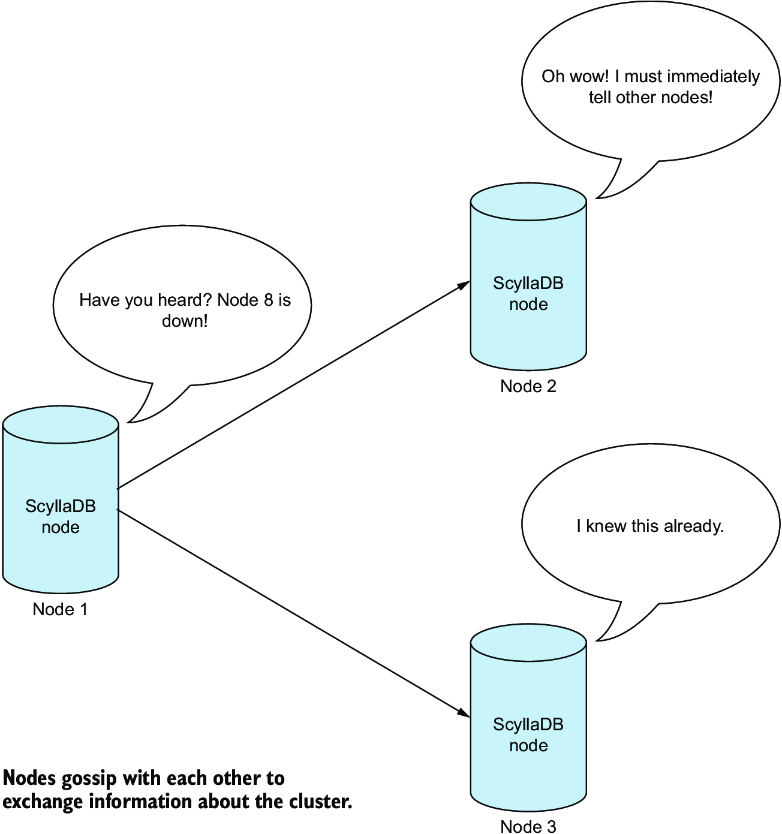
Use the figure to trace how randomly selected nodes exchange state and spread updates through the cluster. section 8.2.4
