Developer wait time is the time developers cannot proceed while waiting for AI-assisted operations or results. It is a hidden cost: it consumes developer time but does not appear on a subscription or API invoice. A lower token bill can therefore leave the largest cost nearly untouched. section 9.1 section 9.4.1
Wait time belongs in the total cost of an AI workflow alongside retries, context switching, and downstream bugs. A slower model may be cheaper per token but more expensive in developer time; a less accurate one can also cause costly reruns. Compare speed and first-attempt success with token price rather than optimizing any one measure alone. section 9.4.1 section 9.6
The cost behind the invoice
For a twelve-person development team, a monthly cost model puts visible AI spending at $1,407 and total cost at $9,407. Developer wait time accounts for $4,400, while retries account for another $1,480. The model assumes each developer works on one task while waiting for one response, so its 85% hidden-cost share is a ceiling rather than an invoice: parallel work can reduce the impact. section 9.4.1
Figure 9.6 Complete monthly AI cost - twelve-person development team.
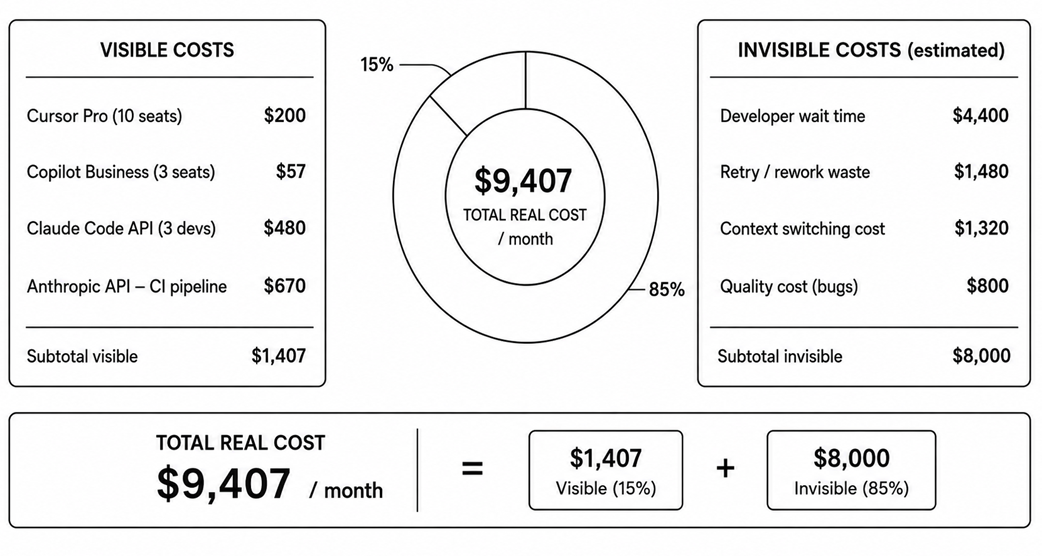
Compare the modeled monthly cost categories for the twelve-person team. section 9.4.1
Evaluate changes by workflow. For interactive pair programming, latency and quality may matter more than the lowest token price; for CI review, cost and quality may take priority. Track first-attempt success and total cost so that savings do not simply move from the API bill into developer time or quality problems. section 9.4.1 section 9.6
