Differentiation measures how quickly a function changes. At one point, the derivative is the incline or decline of the tangent line; across a domain, those measurements form a derivative function. section 5.1.1 section 5.1.2
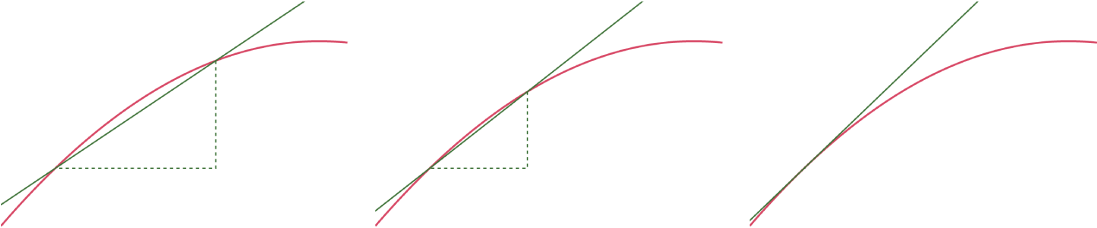
As an interval shrinks, the secant-line slope approaches the tangent-line slope, giving geometric intuition for a derivative. section 5.1.1
Use these patterns to differentiate expressions piece by piece:
- Differentiate a constant to obtain zero, while a constant multiplier remains unchanged. section 5.1.3
- Differentiate a sum term by term and a product with the product rule: (fg)' = f'g + fg'. section 5.1.3
- Differentiate nested functions by multiplying the derivative of the containing function by the derivative of the contained function. section 5.1.3
- Recognize common patterns: linear functions produce constants, quadratics produce linear functions, and cubics produce quadratic functions. section 5.1.2
Differentiate with SymPy
SymPy’s diff utility differentiates expressions directly: diff(x**3 + 2*x**2 + sin(x)) returns 3*x**2 + 4*x + cos(x). Specify the variable for expressions with several symbols, and repeat it to obtain a second derivative. section 5.1.4
Differentiation can continue recursively to produce higher derivatives. Integration reverses differentiation only up to an unknown constant, because differentiation removes standalone constants. section 5.1.4 section 5.6
