Digital identity is the information and relationships that let online systems recognize, remember, and relate to people, organizations, services, things, and digital agents. It turns distant interactions into usable relationships rather than reducing people to credentials alone. section 1.1 section 2.1
Digital identity supports several connected security and business functions:
- Provides the contextual anchor for personalization, privacy, security, and access control. section 2.9
- Expresses relationships such as student–university, contractor–client, or customer–service provider. section 4.2
- Supplies names, attributes, roles, schedules, devices, and other context for authorization decisions. section 2.1 section 4.2
- Requires reliable namespaces and discovery so policies can identify and locate the correct entities. section 2.9
From a café interaction to an online account
A café worker may recognize a returning customer through memory and interaction. A kiosk instead asks the customer to create an account and log in, preserving an identifier and preferences rather than the human relationship itself. More capable identity systems use those stored relationships and attributes to support tailored, secure interactions. section 2.0
Figure 1.1 Embedding access logic throughout application code (left) creates tight coupling. Externalizing authorization into a separate component (right) makes access policies explicit, decouples decision-making from application behavior, and enables scalable, auditable access control.
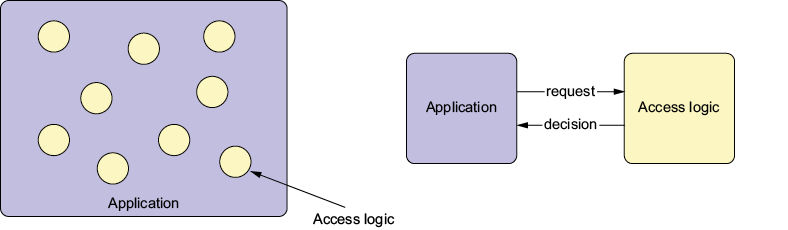
Externalizing authorization from application code makes identity-based access policies explicit, less tightly coupled to application behavior, and more auditable. section 1.1
