Digital subscriber line (DSL) provides broadband internet access by transmitting digital data over existing standard telephone lines. It remains common in some areas, especially for small-office and home-office networks, because it avoids installing new cabling. section 16.2.1
A typical DSL connection uses these components:
- A DSL modem converts between network data and the signaling used on telephone lines. It may be a separate device or part of a wireless home router. section 16.2.1
- A splitter, also called a DSL filter, allows a telephone and modem to share one phone line while filtering their signals to prevent interference. section 16.2.1
- A SOHO router can provide the local network connection while the DSL modem supplies the telephone-line connection to the internet. section 16.2.1
Figure 16.8 A SOHO network connecting to the internet via DSL. A DSL modem translates between Ethernet and the signaling used on telephone lines. A splitter is used to allow both the telephone and modem to connect to a single phone line. The splitter is also called a DSL filter, as it serves to filter the DSL and telephone signals to prevent interference between them.
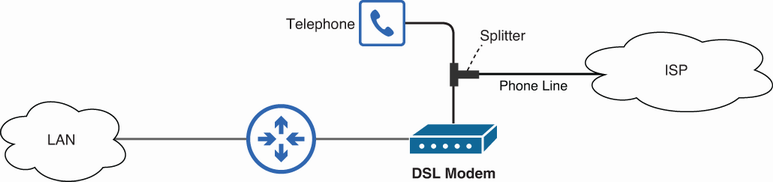
Inspect the SOHO topology showing the DSL modem, Ethernet connection, telephone line, and splitter used to separate telephone and DSL signals. section 16.2.1
DSL uses preexisting telephone infrastructure, like cable internet uses existing cable-TV lines. Fiber-optic Ethernet instead requires fiber installation and typically an optical network terminal or optical network unit to convert optical signals for copper Ethernet. section 16.4
