Fiber-optic Ethernet carries Ethernet communication over fiber-optic cabling using optical signals. Unlike DSL and cable internet, it requires fiber installation to the customer premises and typically uses an optical network terminal (ONT) or optical network unit (ONU) to convert light signals into electrical signals for copper UTP cabling. section 16.2.3
Operational characteristics include:
- Provides substantially higher speeds than DSL or CATV, although installation requires greater initial investment. section 16.2.3
- Appears in SOHO and enterprise networks, including fiber-to-the-home services and provider-offered fiber-optic Ethernet leased lines. section 16.2.3 section 16.4
SOHO fiber connection
A SOHO network connects to the internet through fiber-optic Ethernet. An ONT or ONU receives optical signals from the provider and supplies electrical signaling for the customer’s copper UTP network. section 16.2.3
Figure 16.10 A SOHO network connecting to the internet via fiber-optic Ethernet. An ONT/ONU converts between light and electrical signals.
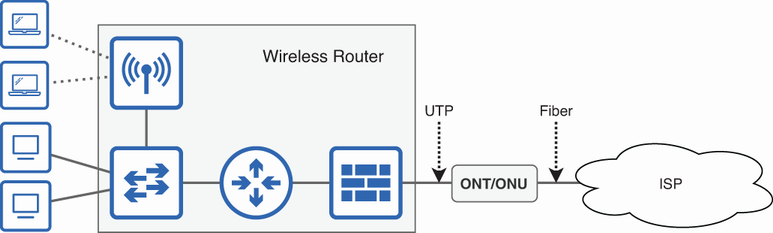
Shows a SOHO internet connection in which an ONT/ONU converts between fiber-optic light and electrical Ethernet signaling. section 16.2.3
