Dense prediction needs broad image context without losing the fine details required for pixel-level labels. Dilated convolution spaces out a filter’s sampling positions, enlarging its receptive field without enlarging the filter or reducing resolution through pooling. Stacking dilation rates of 1, 2, 4, and 8 expands the field of view while keeping each layer’s parameter count unchanged. section 3.5
Dense prediction with VGG-16
Yu and Koltun’s 2015 approach removed pooling and striding layers from VGG-16 and replaced them with dilated convolutions, preserving high-resolution feature maps while gathering broader context. section 3.5
Figure 3.6 Dilated convolutions rapidly expand the receptive field without increasing computational cost. Each dot represents a convolutional kernel element. As dilation increases (from left to right), the receptive field expands exponentially, capturing broader spatial context while keeping the parameter count the same. Used with permission granted by the lead author (Fisher Yu).
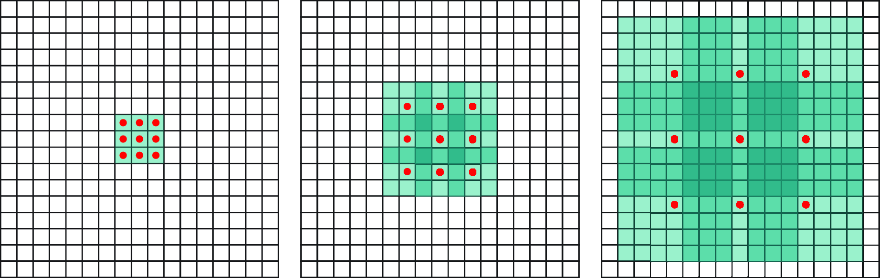
Compare how increasing dilation spreads a filter’s sampling positions and expands its receptive field without changing its parameter count. section 3.5
