Direct Preference Optimization (DPO) aligns a language model with human preferences by training it to favor a chosen response over a rejected one for the same prompt. Unlike reinforcement learning from human feedback (RLHF), it does not first train an explicit reward model and then use reinforcement learning to optimize against that model. section 5.2
Figure 5.1 A simplified comparison of RLHF and DPO and how DPO directly optimizes for the policy without an explicit reward function
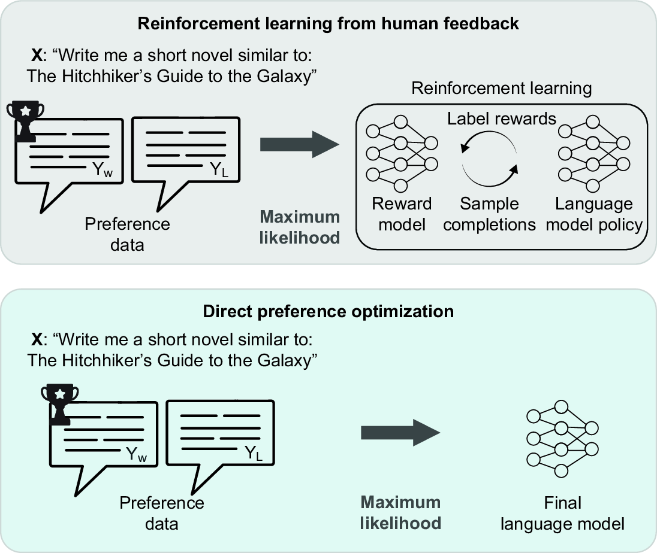
The comparison shows the central workflow difference: DPO optimizes the policy directly rather than introducing a separate reward-model stage. section 5.2
Training uses preference-labeled prompt–response pairs after supervised fine-tuning. The DPO step takes the prompt into account, promotes the chosen response, and deprioritizes the rejected response. Kullback–Leibler (KL) divergence is part of the constraint-based optimization; the preference decision can be understood as a classification-like task. section 5.2
A practical training sequence is:
- Load a previously trained model and add LoRA adapters. Select preference samples; the worked setup samples 1% of UltraFeedback Binarized’s train_prefs and test_prefs splits. section 5.2.2
- Transform chat messages into the prompt, chosen, and rejected fields expected by DPOTrainer. Keep those three fields when mapping the dataset. section 5.2.2
- Configure training arguments, pass the transformed training and evaluation splits to TRL’s DPOTrainer, call train(), and save the model locally or to Hugging Face Hub. section 5.2.2
Listing 5.16 Preparing training data
transformed_datasets = raw_datasets.map(
    lambda example: apply_chat_template(example, tokenizer),
    remove_columns=[col for col in raw_datasets["train_prefs"].column_names
    if col not in ['chosen', 'rejected', 'prompt']],
    desc="Formatting prompt template",
)
The dataset mapping shows where chat formatting happens and which columns survive for DPO training. section 5.2.2
Listing 5.18 Initializing training arguments for DPO training
dpo_trainer = DPOTrainer(
    model=model,
    ref_model=None,
    args=training_args,
    beta=0.1,
    train_dataset=transformed_datasets["train_prefs"],
    eval_dataset=transformed_datasets["test_prefs"],
    tokenizer=tokenizer,
    max_length=1024,
    max_prompt_length=512,
)

# Continue with your training process
longcomment/1/Train the model with DPO/
dpo_trainer.train()
The trainer setup makes the applied choices concrete: beta=0.1, separate training and evaluation splits, a tokenizer, and prompt and sequence length limits. section 5.2.2
DPO’s simpler workflow does not remove every training risk. Its KL-based loss can overfit with deterministic preferences or limited datasets, potentially producing an overly deterministic policy. The trainer offers loss_type="ipo" as a regularization-oriented alternative and loss_type="kto_pair" for Kahneman–Tversky optimization. Model, dataset, and hyperparameter choices remain useful experiments rather than fixed defaults. section 5.2.4

