Disaster recovery restores lakehouse data and operation after failures such as catalog corruption, accidental deletion, software bugs, region outages, or damaging automation. Apache Iceberg reduces logical-recovery risk through snapshot isolation, atomic commits, versioned metadata, rollback, branching, and time travel, but recovery also depends on protecting loosely coupled catalogs, object storage, compute, manifests, snapshots, and data files. section 11.3
A resilient Iceberg recovery design combines several safeguards:
- Back up catalog state and metadata files, including metadata.json, independently from table data. section 11.3 section 11.3.7
- Enable object-storage versioning and replicate complete table paths, including metadata, data, and snapshots, to another region or account. section 11.3 section 11.3.7
- Use branching, time travel, and snapshot rollback for logical recovery when physical files remain available. section 11.3 section 11.4
Automated recovery workflow
A recovery DAG in Apache Airflow or Dagster can register a table from a copied metadata.json file, restore replicated data files, validate snapshot lineage, and update the catalog. Conditions can distinguish a single-table loss from a full catalog outage. section 11.3.7
Figure 11.6 Regular backups, not just of data files but also of metadata files and catalog state, can speed disaster recovery and ensure that storage is in sync with the catalog after recovery.
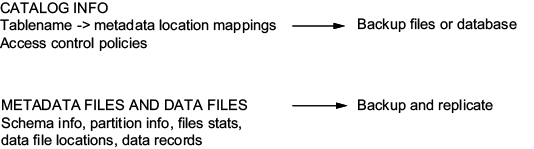
The diagram emphasizes that effective backups include data files, metadata files, and catalog state, keeping storage synchronized with the catalog during recovery. section 11.3.7






