A discount reduces the price offered to a customer. Choosing an effective discount requires separating what predicts a purchase from what would change purchasing behavior. Historical purchase frequency or loyalty can affect both the discount received and the likelihood of buying, making it a confounder. section 3.3.2 section 4.1.4
Evaluate a discount strategy by checking:
- Whether large and small discounts reach both frequent and infrequent customers; otherwise, the positivity assumption may fail. section 3.3.2
- Whether the observed relationship between price and purchases reflects the discount effect or customers’ pre-existing loyalty. section 3.3.2
- Whether a predictive model still applies after changing who receives discounts. section 4.1.4
Changing the discount policy
Suppose an online retailer historically discounts mainly for loyal customers. A model using price alone may predict purchases well because price indirectly signals loyalty. If discounts are extended to occasional shoppers, that relationship changes, and the model may overestimate their purchase probability. Including loyalty and assigning both discount levels across customer groups supports a more reliable assessment. section 3.3.2 section 4.1.4
Figure 3.14 Graph representing pricing discounts based on historical purchasing frequency
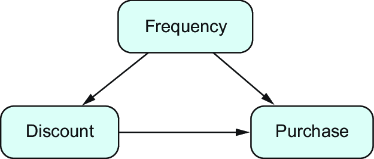
Trace how historical purchasing frequency influences both discount assignment and purchasing, creating a confounding path. section 3.3.2
