A disease pathway is an undirected subgraph of a protein–protein interaction (PPI) network. Its nodes are proteins associated with one disease, and its edges are interactions among those proteins. Pathways can overlap across diseases and exclude the disease nodes themselves. section 4.2 section 4.2.3
A practical disease-pathway workflow combines association data, interaction data, graph extraction, and network analysis:
- Create unique node-key constraints for Protein and Disease nodes in Neo4j. section 4.2.1
- Import experimentally documented human PPI edges, then add disease–protein associations and disease classes from separate datasets. section 4.2.1
- For a selected disease, collect associated proteins and return the interactions among them to extract the pathway subgraph. section 4.2.3
- Measure internal structure and external connectivity using largest-component size, density, pathway boundary, conductance, distance, and concentration. section 4.2.3
Celiac disease pathway
Starting from celiac disease, associated genes are collected from the disease–protein network and connected through the PPI network. The resulting graph can be loaded into NetworkX to calculate pathway density and the relative size of its largest connected component; conductance counts interactions from pathway proteins to proteins outside the pathway. section 4.2.1 section 4.2.3
Figure 4.4 A disease pathway is a subgraph of the PPI network defined by a set of proteins associated with the disease.
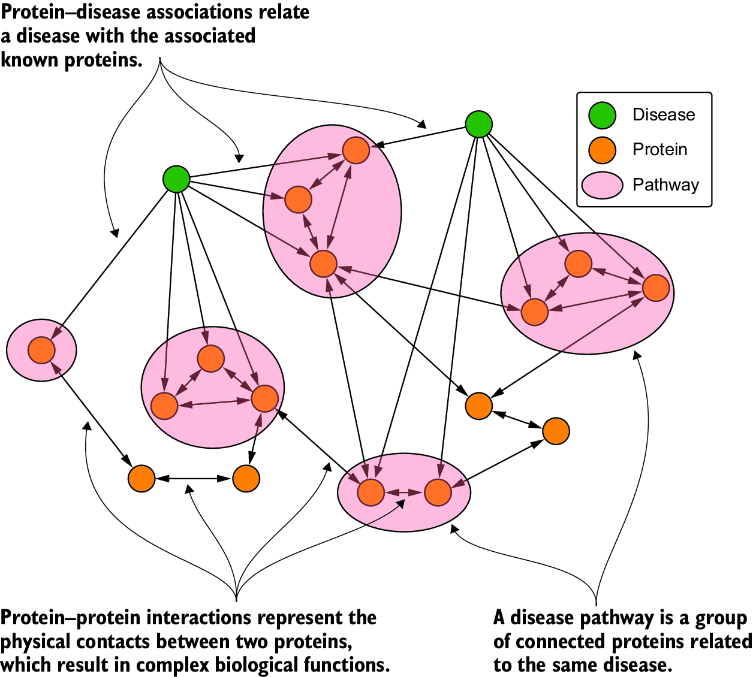
Use the diagram to see how disease-associated proteins define a subgraph within the broader PPI network. section 4.2.1
